Moving to Cambodia
 ByStephen
SafetyWing
- Global coverage in 180+ countries
- Starts under $63 per month
- Buy before or while already abroad
What is Cambodia?
Cambodia is a developing nation in Southeast Asia which offers a lot of opportunities for expats.
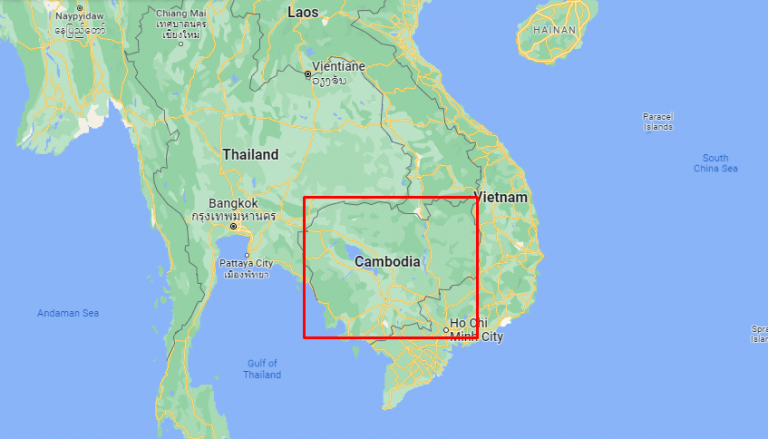
The Kingdom of Cambodia lies at the southern end of continental Southeast Asia and borders Thailand, Laos and Vietnam.
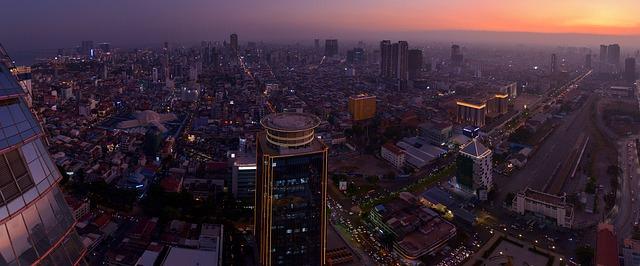
Phnom Penh is its capital and largest city.
Cambodia history
Cambodia was a protectorate of France until 1953, and is currently an elective constitutional monarchy – in theory.
In practice, its level of democracy is very low.
The nation has suffered much in the 20th century, most notably at the hands of mass-murderer Pol Pot and his Khmer Rouge, who ruled officially until 1979, and kept up a guerilla insurgency along the Thai border until as recently as 1998.
Cambodia’s marked by widespread poverty, corruption, lack of political freedom, low human development, high rate of hunger and deforestation.
It scores poorly on water resource management, air quality, sanitation and education.
It’d fit right in with most African countries, in fact.
Cambodia economy and tourism
On the other side of the coin, there is the fact that all of these factors are steadily improving, and in fact Cambodia’s one of the fastest growing economies in Asia, with its economy growing over 7% per year until 2020.
Post-pandemic, however, Cambodia’s GDP growth rate has moderated to a still very nice 4 to 5.3%.
Cannabis is technically illegal but this policy is often not enforced – unless corrupt police officers see a foreigner smoking it up and decide they want a bribe, or said foreigner will spend some time in jail.
Tourism plays an increasingly important role in the country’s economy.
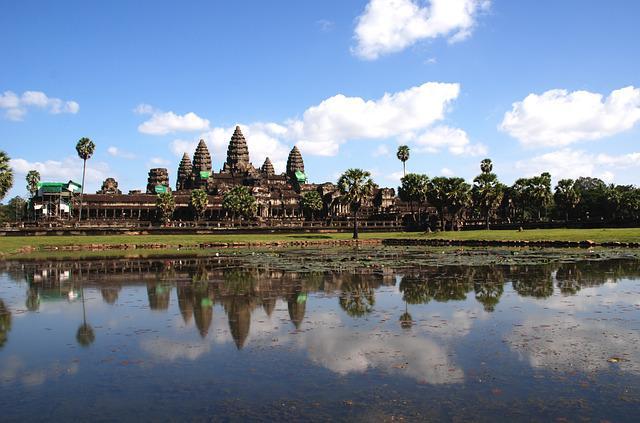
The temples of Angkor near Siem Reap, particularly Angkor Wat, attract millions of visitors each year and are the main international image associated with Cambodia.
The tourism sector provides jobs for large numbers of people, though the benefits are unevenly distributed and the industry remains vulnerable to global shocks.
Another key pillar of the economy is garment manufacturing. Cambodia exports vast quantities of clothing to Western markets, and factories employ hundreds of thousands of workers, many of them young women from rural areas.
Working conditions and wages have long been a point of contention, with periodic strikes and protests over labor rights.
Cambodia demographics
Roughly 18 million people live in this country, of which 97% are Buddhists.
Despite its challenges, the country has a very young population, which gives it significant long-term potential. Urban areas such as Phnom Penh are expanding quickly as people migrate from the countryside in search of work and better opportunities.
This rapid urban growth brings investment and development, but also strains infrastructure, housing and public services.
Foreign investment, particularly from China, has poured into sectors such as construction, real estate and infrastructure.
New roads, bridges and high-rise buildings have appeared at a pace that would have seemed unlikely just a couple of decades ago.
Whether this development ultimately benefits the broader population or mainly enriches political and business elites remains an open question.
Requirements for moving to Cambodia
Moving to Cambodia used to be really easy.
Not only could you easily get a visa, you could also extend this indefinitely.
While Cambodia historically had a very relaxed visa-extension policy, regulations have tightened. Long-term extensions (6 or 12 months) of the EB (Business) Visa now strictly require proof of employment, business registration, or a valid Cambodian Work Permit (issued by the Ministry of Labour and Vocational Training).
You cannot endlessly extend a general resident visa without official documentation unless you qualify under specific categories like the ER (Retirement) Visa (for those aged 55+).
TLDR: long-term stays generally require a work permit at this point.
You can however attain citizenship after 7 years in the country, but this too comes with a strong caveat.
While standard naturalization law specifies a 7-year continuous residency requirement, the actual process is notoriously difficult.
It requires passing a rigorous Khmer fluency/literacy exam, demonstrating integration, and obtaining royal decree approvals.
Very few Western expats obtain citizenship via standard naturalization; most who do acquire it through major financial contributions/investment programs.
In addition, the cost of living in Cambodia is pretty low, which means you do not need to make a lot of money.
Do keep in mind that while base living costs are low, imported goods, international health insurance, and private Western-standard healthcare can be relatively expensive.
Under Cambodia’s Tax on Salary (ToS) system, progressive rates for tax residents (those living in Cambodia for >182 days) range from 0% to 20%. Non-residents pay a flat 20% on Cambodian-sourced income.
This is still considerably less than what you’d pay in your former Western nation, so it’s definitely an upgrade.
The only real requirement for moving to Cambodia, as always, is having your own business which grants you location independent, international income.
That being said, you do have to take into account that Cambodia is most definitely a developing country – but it’s growing and improving rapidly every year.
A couple of years ago, you would have certainly had to “rough” it if you moved there, even compared to neighboring nations such as Vietnam and Thailand.
But currently? Major cities like Phnom Penh and Siem Reap offer modern high-rises, international hospitals, Western grocery chains, high-speed fiber internet, and luxury amenities.
Americans living in Cambodia
There is also a small but noticeable community of Americans living in Cambodia. Drawn by the country’s low cost of living, acceptance of the USD and relatively relaxed lifestyle, a number of expatriates have settled in cities such as Phnom Penh and Siem Reap.
Some come to work in NGOs, education or business, while others simply stay long-term because life is considerably cheaper
A noticeable community of American expatriates calls Cambodia home.
Drawn by an affordable cost of living, widespread usage of the US Dollar, and a welcoming culture, Americans have settled primarily in Phnom Penh, Siem Reap, and coastal towns like Kampot.
The community is diverse: many work for international NGOs, teach English, or run small local businesses, while a growing number of retirees and remote workers enjoy a comfortable lifestyle on modest incomes.
Rent, dining, and daily expenses are significantly lower than in the United States.
However, American expats must still navigate worldwide US tax obligations with the IRS, as well as local banking nuance, such as the gradual phase-out of small USD bills in favor of the Cambodian Riel and digital QR payments.
While the country offers a relaxed pace of life, residents periodically face challenges with bureaucratic unpredictability, underdeveloped public infrastructure, and the need to travel abroad for specialized healthcare.
Nevertheless, with accessible retirement options and an established support network, the American expat community remains a vibrant part of Cambodia’s international population.
What is the cost of living in Cambodia?
The cost of living in Cambodia, as is the case with almost all Southeast Asian countries, is very low.
The minimum annual wage is slightly over $2,800 so it’s really dirt cheap to live there.
A single person can expect to get by easily with less than $1,000 a month – if you’re a frugal expat living in a modest studio apartment, eating local Khmer food, and riding a scooter.
However, in central Phnom Penh, living on $1,000 per month requires sacrifices.
High-end apartment rentals ($400–$800+), Western groceries, western-style dining, imported items (which are subject to heavy import tariffs), high electricity costs ($0.20–$0.25/kWh), and comprehensive health insurance can push an expat budget to $1,500–$2,500+ per month.
While $1,500 to $2,000/month delivers a very comfortable lifestyle, it does not buy immunity from local realities.
Premium Western healthcare, international schooling for children, high-end imported goods, and emergency air-evacuation coverage require significantly higher incomes.
Benefits of living in Cambodia
-
Rapidly growing economy
Cambodia is one of the fastest growing countries in the region economically (and the world) and is expected to continue expanding at this pace for many years to come. Moving and/or investing here will allow you to reap the fruits of riding this economic growth
-
Low cost of living
Cambodia is very cheap and if you earn about $2,500 per month, you will be able to live comfortably.
-
Pretty safe
Cambodia has pretty low crime rates, and even internationally speaking nobody is likely to invade them anytime soon. China is Cambodia’s largest economic donor, infrastructure builder, and military backer. Because China holds massive influence over the Mekong region, none of Cambodia's immediate neighbors would attempt an invasion without triggering a massive diplomatic or economic crisis with Beijing.
-
Rich cultural heritage
Cambodia’s a great country to visit as a tourist, because it has many ancient sites such as Ankor Wat. These aren’t likely to go anywhere, and thus will probably continue to draw tourists and their money to Cambodia, which will keep fueling its growth
Downsides of living in Cambodia
-
Hot and humid
Cambodia’s a Southeast Asian country, and that of course means it’s pretty damn hot and humid
-
Poor
This country’s dirt cheap to live in, and for good reason. It’s considered one of the poorest countries in the region, and its infrastructure, rule of law, and general level of prosperity is behind many of its neighbors
-
Language barrier outside major hubs
While functional transactional English is common in tourist areas, hospitality, and expat neighborhoods in Phnom Penh and Siem Reap, overall English proficiency across the general population remains low. Learning basic Khmer or using translation apps is essential for navigating daily administrative tasks, rural travel, and interactions outside the expat bubble.
Moving to Cambodia - by the numbers
Climate: 6/10
| Hours of sunshine (6/10) | Temperature (3/10) | Rainy days (7/10) | Humidity (4/10) |
|---|---|---|---|
|
35 C – 95 F |
7 |
77% |
Level of English: 2/10
Cost of Living: 7/10
| Minimum Annual Wage | Average monthly cost single person |
|---|---|
Taxes on international income: 6/10
Between 0 and 20%.
For tax purposes, you are considered a resident if you have your principal place of abode there, or are present for more than 182 days during a 12 month period.
Residents are liable for taxes on worldwide income and profits, while non-residents are only taxed on Cambodia-sourced income.
Don’t be a resident here, don’t get your income from the country, and you do not have to pay international income tax.
Economic growth: 9/10
Average GDP growth over the last 10 years: 5%, yet before that it was at a very healthy 7.7%.
This country is making rapid economic progress, Cambodia will almost certainly keep growing strongly in the next few decades.
Safety: 8/10
| Global Terrorism Index (10/10) | Intentional homicide rate (9/10) | Rape rate (5/10) |
|---|---|---|
|
Moderate |
Visa: 4.7/10
-
Visa (7/10)
Initial entry is straightforward via an Ordinary (E-class) visa on arrival. However, long-term extensions (EB) are no longer unmonitored; they strictly require a valid Cambodian Foreigner Work Permit, company registration, or local tax documentation. Retirees (ER) aged 55+ still enjoy accessible renewals, but remote workers operate in a tightening legal framework.
-
Permanent Residence (3/10)
Standard permanent residency programs do not practically exist for regular expats. Most long-term residents instead rely on recurring annual visa extensions. Multi-year residency is only available via specialized high-net-worth investor tracks, such as the Cambodia My Second Home (CM2H) scheme.
-
Citizenship (4/10)
Naturalization is legally possible after 7 years of continuous residence, but it is exceptionally difficult to obtain in practice. Applicants must prove written and spoken Khmer language literacy, pass a history exam, and secure government approvals. Outside of marriage, citizenship is almost exclusively granted through major capital investments or official donation programs.

How is life for expats in Cambodia?
Life in Cambodia as an expat can be pretty great or extremely depressing, depending on your priorities and tolerance for subpar living.
You won’t have to spend much money in Cambodia, because it’s pretty cheap to live there.
The poor infrastructure and general low level of development might hinder your happiness, if you’re used to comforts as can be found in Dubai and Singapore.
This does provide you with many opportunities for making money, such as starting a business.
A couple of years ago, when I first wrote this article, Cambodia scored much, much higher. It was one of the premier options in Southeast Asia.
However, in the past 4 years or so, a few important things have changed.
- Its visa system and long-term stay system has gone from “Excellent!” to … really not that good.
- The cost of living has gone up quite significantly. It’s still cheap, but definitely not as much as before.
While today it isn’t very awesome to live in (although cheap and easy to arrange), the booming economy virtually guarantees that in a few decades time, Cambodia will be very different from today.
Would I move to Cambodia? As it stands, I would not, because I have a family to raise and the educational system doesn’t seem very impressive.
If I weren’t so burdened, however, I would definitely consider Cambodia to live in for awhile, and set up some of my Bases in.
In addition, Cambodia has a great central location, and from its capital you can easily hop between other interesting nations in the area, such as Thailand, Vietnam, Malaysia and the Philippines.
An interesting option for sure, and if you don’t mind living without much luxury, you can do very well in Cambodia.




What are the modern comforts you refer to that can be found in Dubai and Singapore and not in Cambodia?
For example, an efficient public transportation network like Singapore’s Mass Rapid Transit (MRT) subway system. And in general, I’d say the level of infrastructure (both on the macro and the micro) in Cambodia is way lower than in those countries.
Sure, you can find high quality living in some parts of Cambodia, but that is certainly an exception and not the rule.