Moving to Colombia
 ByStephen

SafetyWing
- Global coverage in 180+ countries
- Starts under $63 per month
- Buy before or while already abroad
Colombia is a Spanish-speaking Latin-American republic
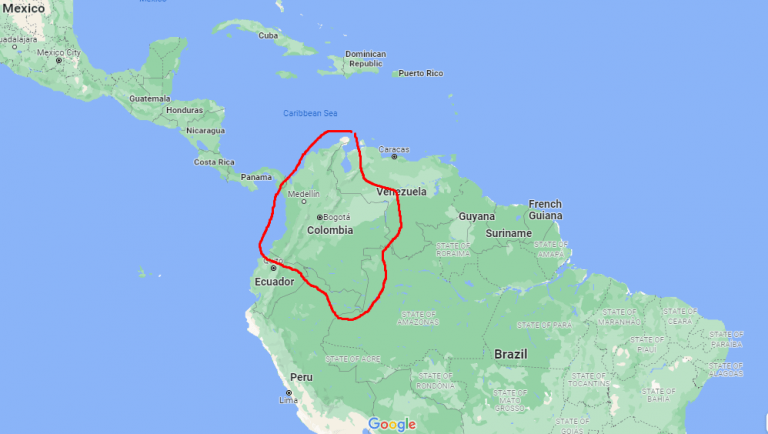
Colombia lies in South America, and shares borders with Brazil, Venezuela, Ecuador, Peru, Panama, the Pacific Ocean and the Caribbean Sea.
It’s a big country with a population of roughly 50 million and a diverse range of climate zones. You can find tropical rain forests, deserts, mountain climates, savannas and steppes.
Colombia history
This country, like all of its neighbors, is a former colony of Spain, which means Spanish is the official language.
This is great news, because Spanish is easy to learn, and if you master it, you get access to almost all of the other Latin-American countries.
Colombia is pretty well-known across the West for its problems with drug cartels and crime.
In the last century, armed conflict and political violence were indeed running rampant throughout the country and its shabby reputation was well-earned.
However, since the early 2000’s, this country has been getting its shit together, and it has seen significant improvements in its economy, safety, stability and development.
Colombia economy
Colombia has been growing rather consistently the past 20 years (COVID-19 notwithstanding) and is expected to keep doing well in the next few decades.
This gives it strong trade potential and has contributed to its economic growth over the past two decades.
The country’s economy is fairly diversified for the region, with key sectors including oil, mining, agriculture, and increasingly services and tourism. While still considered a developing economy, Colombia has built a relatively stable macroeconomic foundation compared to many of its neighbors.
Colombia is also one of the most urbanized countries in Latin America, with over 80% of the population living in cities. Major urban centers like Bogotá, Medellín, and Cali dominate the economic and cultural landscape, each offering very different lifestyles.
Colombia safety
It’s also worth mentioning that Colombia has undergone a major transformation in terms of security.
While the country still faces challenges, especially related to organized crime and certain rural areas, violence levels are significantly lower than during the peak decades of cartel and guerrilla conflict.
For example, homicide rates were once above 60 per 100,000 in the 1990s but have declined substantially since then, even if they remain elevated by global standards today.
Colombia still sports somewhat elevated crime numbers, but these numbers are mostly inflated because of some specifically dangerous zones.
Purely looking at the murder rate, it’s at about 25 murders per 100.000 inhabitants per year on average.
This is pretty high, compared to the overall United States number of 7.5 per 100.000 – which takes into account every small town.
Then again, cities like Chicago are more dangerous than Colombia, with roughly 28 per 100.000.
If you aren’t being an idiot and waving your cash around, or going out alone at 3 AM in dangerous neighborhoods, Colombia can be perfectly safe.
Colombia climate and geography
Bogotá is a massive, high-altitude capital with a cooler climate, Medellín is known for its mild “eternal spring” weather, and coastal cities like Cartagena and Barranquilla offer a much more tropical, Caribbean-style environment.
Another important aspect of Colombia is its strategic location and access to both the Pacific Ocean and the Caribbean Sea.
Finally, Colombia has a young and growing population, with a median age in the low 30s.
This creates a dynamic labor market and contributes to its long-term growth potential, especially as urbanization and foreign investment continue.
Combined with improving infrastructure and increasing international interest, this positions Colombia as one of the more promising countries in Latin America over the coming decades.
Requirements for moving to Colombia
Colombia is amazingly accessible and the requirements for living here used to be very, very easy to meet.
However, things have changed.
Colombia has significantly tightened its immigration requirements in recent years. While entering as a tourist is straightforward, living there legally long-term requires qualifying for a specific visa category (e.g., Digital Nomad, Investor, or Pensioner).
Applications require apostilled and officially translated financial records, health insurance, criminal background checks, and strict minimum foreign income proofs (e.g., the Digital Nomad visa requires proving an income equal to at least 3x the Colombian minimum wage, roughly $1,100–$1,400 USD/month).
In addition to that, Permanent Residence and Citizenship are possible, but not easy and fast to get:
- Permanent Residency (R Visa): You cannot apply for an R Visa directly. You must first hold a qualifying Migrant (M) Visa continuously for 2 to 5 years depending on the subtype. Tourist time and Digital Nomad Visas (V-Nomad) do not count toward this clock.
- Citizenship: Requires holding Permanent Residency for 5 additional years (or 2 years if from a Latin American country/Spain) before applying. The process involves comprehensive background checks, a Colombian history and geography exam, and a naturalization interview conducted entirely in Spanish.
So yes, you do need to learn Spanish, but honestly, this would be required anyway if you plan to live here.
One strong requirement for moving to Colombia is making sure you have a source of international, location independent income.
(Or even better, have several different sources, such as selling information, blogging, real estate, consulting, and so on!)
You do not want to rely on a pension from a Western government, a remote job, or a job in Colombia.
Having foreign income satisfies the financial requirement for a Digital Nomad visa, but it is far from the only requirement.
Be your own boss, be self-employed and earn money from all over the world, wherever and whenever you want, and you can easily live in Colombia.
However!
- Legal Stay Limits: As a tourist, you are legally capped at 180 calendar days per calendar year (90 days on arrival + one 90-day extension). You cannot stay permanently without a visa.
- Tax Residency: If you reside in Colombia for more than 183 days in a rolling 12-month period, you become a Colombian tax resident, meaning you are legally required to report worldwide income and assets to the DIAN (Colombia’s tax authority)
What is the cost of living in Colombia?
The cost of living in Colombia is very low.
In South-America, it is one of the best countries to move to if you want to get the most bang for your buck.
Living in Colombia used to be even cheaper than other countries which are known for an inexpensive lifestyle, such as Thailand and the Philippines, but this isn’t the case anymore.
On average, overall cost-of-living indices rank the Philippines and Thailand as cheaper or comparable to Colombia, particularly regarding long-term housing, street food, and everyday public infrastructure.
Furthermore, when accounting for inflation and currency fluctuations, living costs in major Colombian hubs (like Medellín or Cartagena) have surged, making them noticeably more expensive than regional hubs in Southeast Asia (such as Chiang Mai or Da Nang).
A single person’s estimated monthly costs used to be around $400, without rent, a few years ago, but have since shot up to $650-720! In larger, major expat destinations, this is even $800+ without rent!
If you add rent, this comes to roughly $1,600 per month.
Still cheap, but not as good as it used to be.
That said, even in these areas, rent, food, transportation, and services remain far below Western standards, allowing for a very comfortable lifestyle at a fraction of the cost.
You can check updated, city-specific breakdowns on to get a more precise idea based on your preferences.
It’s also worth noting that local purchasing power plays a big role here. Salaries in Colombia are relatively low compared to Western countries, which is one of the main reasons prices are so affordable.
For foreigners earning in dollars or euros, this creates a strong advantage. Everyday expenses like dining out, domestic help, gym memberships, and transportation are all highly accessible.
Benefits of living in Colombia
-
Rising nation
Colombia has seen significant growth in the last few decades, and while this has slowed down lately, it is still expected to keep growing in the future at a modest, moderate trajectory.
-
Decent climate
Colombia boasts a varied climate. That means that there are hot and cold areas, dry and rainy regions, and so on.
-
Low cost of living
Colombia is a decently cheap country to live, especially if you have a Western income
-
Spanish
Colombia has Spanish as its national language, and Spanish is rather easy to learn. This means that, even though the level of English is subpar, you should be able to communicate with everyone - provided you put in some effort - and rest assured this effort will be appreciated by the locals
-
Beautiful nature
Interested in a country which has beaches, mountains, jungles, savannas and more? Then Colombia is for you - although I would advise you to stay well-clear of the jungles, for obvious reasons. Colombia is the second most biodiverse country on Earth (beaches, Andes mountains, Amazon, coffee regions, deserts).
-
Great visa situation
Colombia sports a very relaxed visa situation. Most Westerners do not even need to apply for one beforehand, they can just get a tourist entry stamp (PIP-5 permit), which is valid for up to 90 days (extendable to 180 total per calendar year).
-
Hot women
Colombian women are very attractive. Sure, tastes differ, but for most men, big tits and asses are a definite turn-on, and you'll find that a-plenty in this country
Downsides of living in Colombia
-
Low English proficiency
The average Colombian scores rather poorly on the English proficiency test, so the language barrier might be a deal-breaker for you - unless you learn Spanish. In addition, keep in mind that this factor will most likely keep improving as the country develops. QED: when I first wrote this article, they were at Very Low Proficiency, but have since gone up to Low. Still not great, but getting better.
-
While Colombia has made great strides forward in this regard, corruption is still rampant at all levels of government. The same goes for petty crime - inside and outside the government
-
Developing country
The nation is doing pretty well economically and developmentally, but it cannot be denied that you'll probably have to lower your standards a bit
-
High murder rate
Colombia has a murder rate of about 25 per 100.000 inhabitants. A large portion of urban homicides stems from interpersonal disputes, armed street robberies, and local gang territorial control, rather than full-scale cartel-vs-government warfare of the 1980s/90s. This is pretty high compared to the average of most Western countries, but keep in mind that certain Western cities do even worse.
How is living in Colombia as an expat?
I’ll be the first to admit that living in Colombia as an expat isn’t for everyone.
The country certainly isn’t perfect, and still has to deal with a lot of problems before it can be one of the best options to escape the West, but it’s getting there.
The weather’s great in most locations (just not on average across the entire country), the cost of living is low (but unfortunately, steeply rising), the women are attractive, the economy isgrowing (not booming, but going up), you can easily learn the local language, and if you aren’t deterred by the elevated crime rate in some zones (mostly avoidable by not being an idiot), Colombia is a great country in Latin America for expats.
Turning it into one of your Bases is certainly an option. Investing in this up-and-coming country seems like a smart move, but living here permanently is something I cannot 100% recommend – but it’s very close to it.
Is moving to Colombia for you? Get your location independent income up and running, book a trip, and find out.