Moving to Brazil
 ByStephen

SafetyWing
- Global coverage in 180+ countries
- Starts under $63 per month
- Buy before or while already abroad
What is Brazil?
Brazil is a Portuguese-speaking country in Latin America, known for its beautiful women
The Federative Republic of Brazil is the largest country in Latin America (in many aspects), the only Portuguese speaking country in the area, and a pretty interesting nation.
Brazil geography and climate
Let’s start with its size.
There’s no denying Brazil is a juggernaut, with a population of 211 million people, 7500 kilometers of coastline, 4 time zones, it’s the world’s f5th largest country and the 7th most populous.
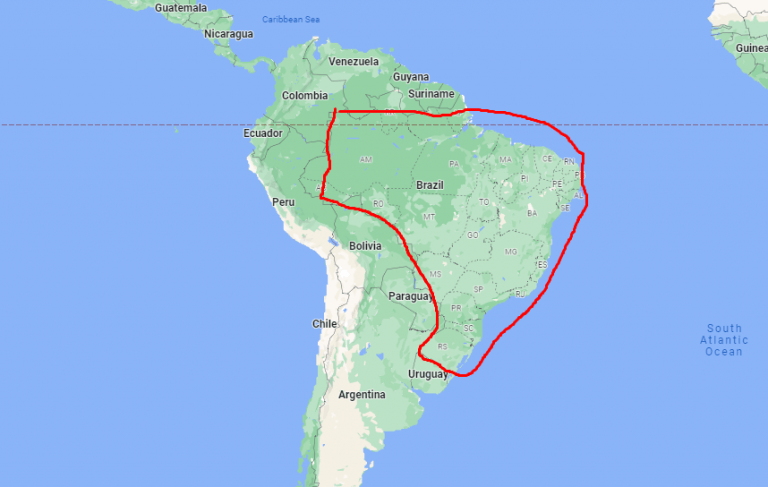
It borders every single country in South America except Chile and Ecuador, and covers nearly 50% of the continent. In addition, it’s the longest country in the world (distance from north to south).
Brazil is one of 17 megadiverse countries in the world, has a massive tropical forest, a variety of ecological systems, many protected habitats, diverse topography (hills, mountains, plains, highlands, and so on), multiple climates (most of the country can be considered tropical though) and is very multicultural and ethnically diverse.
Brazil spans several climate zones (Tropical, Equatorial, Semi-arid, and Subtropical). Significant regions (including the vast Cerrado (savanna), the Pantanal, and parts of the Southeast) experience a distinct and pronounced dry season (typically from May to September)
It has a very clement average temperature of 25 degrees Celsius (77 Fahrenheit).
Brazil history
Its history is pretty similar to most other countries in the area.
It was a Portuguese colony until 1808, when the Portuguese royal court relocated to Rio de Janeiro, eventually leading to full independence in 1822.
Brazil has had a rough path since then, with multiple coups, civil unrest and a steadily improving economy.
Currently it’s a democratic federal republic with Brasilia as its capital.
Brazil economy
Brazil can be considered an emerging power, an advanced emerging economy, and a newly industrialized country – although the last few years have seen a significant decrease in economic growth.
It’s still the largest economy in Latin America and one of the world’s major breadbaskets, but there is also plenty of corruption, crime and social inequality.
In fact, there are above average levels of violent crime, very high levels of gun violence and homicide, and it has the third largest prison population behind China and the US.
Internationally speaking Brazil is doing well, as it follows a policy of non-intervention in the affairs of other countries and opts for peaceful dispute settlement.
Isn’t that nice?
Brazil hasn’t handled COVID-19 well at all, and boasts the second highest death toll in the world (after the US).
Prostitution is legal, and weed isn’t.
Requirements for moving to Brazil
If moving to Brazil is something you are considering, then I’m happy to let you know that the requirements for doing so aren’t very strict at all.
Brazil is easy to move to, mostly because of its great visa system.
Most Westerners do not even need a visa if they stay up to 90 days, after which your stay can be extended.
While European Union passport holders enjoy visa-free entry for up to 90 days, citizens from countries like the US, Canada, and Australia must obtain an e-Visa prior to arrival.
Remote workers like us can obtain Brazil’s Digital Nomad Visa (VITEM XIV) by proving a foreign income of at least $1,500 USD per month.
Brazil residency
Getting permanent residency is also possible, if you are an investor or can qualify for a retirement visa with a verified passive income of at least $2,000 USD per month.
You can even get citizenship after a few years!
You can apply for citizenship after 4 years of permanent residency(or just 1 year if you marry a Brazilian citizen or have a child born in Brazil) provided you pass a basic Portuguese language test.
The cost of living in Brazil is also very low, so this will most likely not be a problem for you at all.
I would say that the only requirement for moving to Brazil is your ability to make a few thousand dollars per month through international income.
Once you get that sorted, you can easily move to Brazil.
What is the cost of living in Brazil?
The cost of living in Brazil is very low, as it is still a developing country.
If you earn $1,000 per month, you will be able to stay in Brazil and live a decent life.
However … while $1,000 USD (~5,000–5,500 BRL depending on exchange rates) is well above the Brazilian minimum wage and allows a comfortable lifestyle in smaller cities or countryside towns (the interior), it can be tight in tier-1 expat neighborhoods in São Paulo, Rio de Janeiro, or Brasília, where rent for a modern, secure apartment alone can take up most of that budget.
As with most other countries I talk about on this site, I do advocate that you aim for at least double that amount.
This will give you plenty of breathing room in case something goes wrong, or if you just want to live it up a bit more.
As an emerging market economy, Brazil offers a living cost significantly lower than Western nations while still providing modern urban infrastructure.
Its economy is growing so the cost of living will keep increasing, but at the moment it’s still very low.
While local prices rise over time with inflation, foreign currency earners like us often benefit from favorable exchange rates against the Brazilian Real, keeping relative costs low.
Benefits of living in Brazil
-
Low cost of living
Living in Brazil can be done on a budget, and if you make $1,000 to $2,000 per month, you’ll be just fine.
-
Decent weather
Although Brazil can be pretty damn humid at times, the average temperature is clement and very pleasant. While temperatures are pleasant year-round, tropical regions do experience heavy downpours during the wet season
-
Beautiful nature
Brazil is one of the few megadiverse countries in the world, and sports exceptionally beautiful vistas and natural sights. Beaches, forests, mountains, plants, animals, you name it
-
Safe internationally speaking
Brazil is very unlikely to get involved in a war, because it has peaceful relations with just about everyone
-
Great visa system
Brazil reinstated its e-Visa requirement for citizens of the United States, Canada, and Australia. Passport holders from these countries must apply and pay for an electronic visa online prior to boarding. Citizens from European Union countries and the UK still enjoy visa-free entry for up to 90 days. Permanent residence and citizenship are also possible and reasonably easy to get
-
Beautiful women
Brazil’s known for its gorgeous and hot women, and I can attest that this is no false claim
-
Prostitution is legal
If you’re into paying for sex, you’ll feel right at home in Brazil because not only is this legal, it’s also cheap

Downsides of living in Brazil
-
Unsafe nationally speaking
Brazil has elevated crime levels, and while its total homicide numbers are high, violent crime is heavily concentrated in specific neighborhoods and northern states, whereas major southeastern areas like São Paulo are significantly safer. I wouldn’t worry about this too much, because if you stick to safer areas and aren’t a dumbass who goes around flashing cash and smartphones in the favelas, you’ll probably be fine
-
Corruption
Brazil is still developing and the income inequality is rather large, so police and politicians are often corrupt. The country faces significant socioeconomic inequality, which contributes to localized corruption among public officials and police.
-
Humid
The weather’s pretty great, but the humidity ensures you’ll be sweating a lot. That said .. the Central-West region (including Brasília) experiences an extreme dry season from May to September, with humidity dropping below 15–20% (similar to desert conditions). The Southern states (Rio Grande do Sul, Santa Catarina, Paraná) experience mild, cool, and temperate climates with low summer humidity and freezing winter temperatures.
-
Low levels of English
English isn’t widely spoken in Brazil (yet), so if you venture outside of the touristy spots, it’s recommended you learn some basic Portuguese (not difficult) or use a translation app

How is life for expats in Brazil?
If you want to become an expat in Brazil, there are several ways how this can be considered a great move.
Brazil’s got a low cost of living, and if you earn at least $1,000 a month you should be fine to live by yourself.
The weather’s pretty great too, and you can enjoy all the natural sights this country has to offer, such as beautiful beaches, mountains, and forests.
The pretty girls are certainly a massive bonus if you’re a man, as is the fact that prostitution is legal (if you can’t be arsed to get sex the old fashioned way).
Now, apart from the great weather, low cost of living and hot girls, Brazil is also known for its rampant and elevated levels of crime.
While you probably will not experience much of this yourself, there is certainly the chance that you will – and you will have to take this into account.
The low level of English is very disappointing as well, because while learning Portuguese isn’t very difficult, there aren’t many other countries you can use this skill in.
However, if you view it as a purely numerical issue … in South America alone, Portuguese speakers make up approximately 50% of the total population because Brazil represents half the continent’s population.
Portuguese is the 6th most spoken native language in the world (over 260 million native speakers), making it globally significant.
Of course, this is mainly due to Brazil’s scale, but it can also be used in 9 countries across Europe, South America, Africa, and Asia (e.g., Portugal, Angola, Mozambique, Cape Verde, East Timor). Of course, none of these are countries I’d recommend you move to, making this point mooit.
Spanish on the other hand can be used in 90% of the other Latin American countries, and thus it seems like a much better option to put time into.
I would suggest using Brazil as a country you visit for a vacation, but not to plant any flags in.
Yes, you could get residence, but there are better options in the area (neighbors Paraguay and Uruguay come to mind) and for your other flags it isn’t too great either.
SafetyWing
- Global coverage in 180+ countries
- Starts under $63 per month
- Buy before or while already abroad