Moving to Argentina
 ByStephen

SafetyWing
- Global coverage in 180+ countries
- Starts under $63 per month
- Buy before or while already abroad
What is Argentina ?
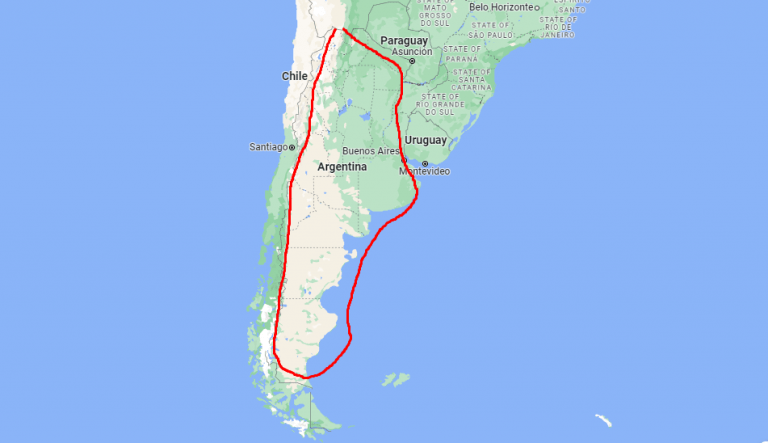
Spanning a territory of over 1 million square miles, Argentina is the second largest country in South America and the largest Spanish-speaking nation in the world (based on area).
It borders Chile, Bolivia, Paraguay, Brazil and Uruguay, with which it has amicable relations, as they are members of MERCOSUR (of which Argentina is a founding member).
Argentina history
As with most other Latin American countries, Argentina was a Spanish colony until 1816, and in the decades to follow it was famously chaotic and plagued by brutal civil wars between the Unitarios (centralists) and Federales (federalists), alongside the long authoritarian dictatorship of Juan Manuel de Rosas.
True economic growth and political stability did not materialize until the unification under the 1853 Constitution and the late 19th century (around 1880–1914).
This massive economic growth propelled it to the forefront of the international stage.
In the early 20th century, Argentina was the world’s 7th wealthiest nation.
Of course, this didn’t last, and in latter half of the 20th century it saw multiple coups, democratic reversals, civil unrest, and generally turbulent years.
Argentina civics
Currently it’s a republic: a federal state within which all 20+ provinces and the capital of Buenos Aires have their own constitutions, but do exist under a federal system.
Pretty similar to the US, in fact.
It’s still a developing country, and it has some catching up to do … but not much, as it is second highest on the Human Development Index in Latin America, and scores high on literacy rates, and relatively low on crime levels.
Argentina is a regional power, and is rich in natural resources.
Its export-oriented agricultural sector and high levels of tourism cause it to maintain a rather large economy, even though the economic growth has slowed down to a trickle the last few decades.
It boasted the largest railway system in Latin America, which linked all provinces and even connects all neighboring countries.
Today, passenger rail services primarily serve the Greater Buenos Aires commuter area, with limited long-distance regional passenger trains.
It does not actively connect all provinces anymore or run seamless international passenger lines to all neighboring countries. Brazil boasts larger overall freight rail capacity.
Argentina’s a melting pot of cultures, and can rightfully be called a nation of immigrants.
As can be expected, European influence is predominant.
Argentina climate
Climate wise, Argentina’s very diverse, and it features warm, moderate, arid and cold climates, but most populated areas are temperate and generally pleasant.
This is one of the most biodiverse countries in the world and has one of the greatest ecosystem varieties, such as the Pampas (lowlands, vast plains), forests, mountains (the highest point in the Southern Hemisphere, the Aconcagua), rivers, and plenty of national parks.
Argentina demographics
Argentina has a population of 46+ million, which isn’t much considering its size, and it has a low population density.
This is one of the safest nations in Latin America, but petty crime and corruption still occur, of course.
Argentina is one of the most socially advanced nations in the area (partly influenced by Uruguay, but Argentina’s really the regional pioneer in social rights), and things like gay marriage, prostitution and cannabis are legal or decriminalized.
If you want to raise a family here, you’ll be pleased to know that there is universal, secular and free public education for all levels.
Partly because of this, Argentinians have relatively high proficiency in English, and 21% of the population is nonreligious.
Requirements for moving to Argentina
Moving to Argentina as a Westerner is usually very easily done.
Going to the country isn’t an issue, as you most often do not even need a visa for a stay of up to 90 days, after which you can extend your stay for another 90 days.
Argentina permanent residency
If you are retired and make at least $1,300 a month, you can get Permanent Residence.
- The minimum income threshold for the Pensionado (Retiree) visa is tied by law to 5 times Argentina’s national minimum monthly wage (Salario Mínimo, Vital y Móvil or SMVM). Due to inflation and official wage adjustments, 5x the SMVM comes out to roughly $1,200 to $1,300 USD per month. However, you do need to start on a temporary residence permit.
- A Financier Visa offers a similar approach, if you can prove you have a steady income. The official name of this pathway is the Visa de Rentista (Passive Income Visa). Like the Pensionado visa, it requires proving passive income (such as dividends, foreign property rentals, or annuities) equivalent to 5 times the national minimum wage (~$1,200–$1,300 USD/month). It does not accept active employment or remote work salaries as passive income.
Investing around $5,000 in a business or “activity” in the country is another option, but this … well, this is complicated.
Historically, the traditional Inversionista (Investor) visa required a business investment of 1,500,000 Argentine Pesos (which was once ~$100,000 USD, though hyperinflation eroded the peso figure).
However, the immigration department heavily scrutinizes low-dollar business plans, requiring proof of economic viability and employment creation.
Furthermore, Argentina introduced formal citizenship/residency-by-investment thresholds setting direct financial contributions significantly higher.
Argentina citizenship
After 2 years of living here, you can even apply for citizenship!
Unlike most nations where citizenship is processed administratively by immigration, naturalization in Argentina is a judicial process handled by federal judges. In practice, background checks, federal court backlogs, and appeals mean the court process routinely takes 1.5 to 3 additional years after filing.
Other factors
The level of English is rather high (compared to many other Latin American countries), so the language-barrier isn’t as thick.
I’d still advise you to learn Spanish though.
The cost of living is low, on average, so if you make a solid income, living in Argentina shouldn’t be a problem.
What is the cost of living in Argentina?
The average cost of living in Argentina for a single person is about $1,100 to $1,400 per month.
This is pretty low, and something everyone with an international income should be able to get.
(Note: this number has increased by about 70-80% since I first wrote this article, so it’s getting more expensive to live in Argentina every year)
$650–$800 USD might cover a local living frugal baseline in smaller secondary cities (like San Juan or Salta) or a shared flat, but for an expat seeking a comfortable standard of living in Buenos Aires, it is dangerously low.
Keep in mind that if you want to live a bit more extravagantly, or if you’ve got a family to support, you’ll have to make at least $2,500 to $3,000 per month.
In summation, yes, you can easily survive on $1,500 per month as a single person, but as with every other low-cost-of-living-country I’ve talked about, I would suggest you aim for double that amount.
Benefits of living in Argentina
-
Beautiful nature
Argentina offers a stunning array of beautiful vistas, such as the pampas (lowlands), mountains, rivers, forests, and so on. It’s a highly biodiverse country, with over 30 natural parks
-
Pretty safe
This country is one of the safest options in Latin America, and has crime rates lower than many Western nations
-
Cheap
Argentina has a low cost of living, and if you make $1,000 a month you should be able to live here. I do advocate making at least double that, to account for emergencies and so on
-
High English proficiency
Argentina has one of the most literate populations in Latin America, and English proficiency is of a high level
-
Socially advanced nation
Gay marriage is legal, cannabis and prostitution are mostly legal and/or decriminalized. There is universal, secular and free public education for all levels
-
One of the least religious countries
Argentina’s non-religious number over 21% of the population, a very high number in the mostly Catholic South America
-
Great visa system
Moving to Argentina and staying there are definitely on the easier side
-
Public transportation
Argentina has a historically impressive network that now primarily functions as a commuter system around Buenos Aires and select main corridors.
-
Strong economy
Argentina has a a large, resource-rich regional economy (3rd largest in Latin America), but keep in mind its notorious economic volatility and inflation cycles.
-
Agreeable climate
Argentina is truly massive and has a great variety of climates, so this heavily depends on where you end up, but on average it’s pretty clement

Downsides of living in Argentina
-
Taxes on international income
If you reside in Argentina, you’ll be taxed on your worldwide income, at progressive rates up to 35%.
-
Corruption
While it's nowhere near as bad as in other countries, there is still a prevalent level of petty corruption in government. Petty street corruption (like police asking for bribes) is actually much rarer in Argentina compared to countries like Mexico, Colombia, or Peru. In Argentina, corruption is primarily institutional and bureaucratic, manifesting as red tape, regulatory friction, dynamic exchange rate/banking controls, and slow judicial proceedings rather than everyday street-level bribery.
-
Volatile economy
Over the last 10 years, Argentina’s economy has grown at a snail’s pace. This country deals with extreme macroeconomic volatility. Over the last decade, Argentina hasn't just grown slowly, it has cycled through hyper-inflation, currency devaluations, complex parallel exchange rates (like the Dólar Blue), capital controls (cepos), and sweeping economic reforms.

How is life in Argentina for expats?
Life in Argentina for expats can be really awesome.
This massive country is very obviously one of the best options in Latin America to escape the West from, just like its neighbors Uruguay and Paraguay.
- To start off with, their visa system is brilliant, allowing you to go there without the need to arrange for a visa, after which extending your stay can be done in various, and often very easy, ways.
- Want to become an Argentine citizen? Also possible!
Argentina has become noticeably more expensive in USD terms compared to previous years.
While it remains attractive compared to North America or Western Europe, single digital nomads and expats should budget closer to $1,200 to $1,500 USD/month for a comfortable life in major hubs like Buenos Aires.
The standard of living is high, many people speak English, and it’s a socially advanced nation so things like gay marriage, cannabis and prostitution are legal.
If you want to travel around and explore the beautiful and varied nature, Argentina is for you.
The country’s one of the safest nations in the Americas, and the public transportation network is excellent (however, while long-distance buses (micros) are phenomenal and extensive, passenger trains do not seamlessly connect the entire country anymore!).
Argentina’s a nation of immigrants, so you’ll feel right at home.
The greatest disadvantage in my opinion, and the factor that stops it from being THE best option in Latin America, is the fact that you’ll have to pay taxes on your international income.
This really is a major factor for me, I could never make it my main living Base as up to 35% income tax really does not appeal.
(Getting residency and/or citizenship does seem like an option, as long as you only use it as your 2nd or 3rd country for that, and don’t spend enough time there to have to pay taxes).
You can always argue that that it’s unlikely the government will find out how you make money and how much, if your businesses are in other nations and you take other precautions.
However, this approach doesn’t seem like a solid long-term strategy, especially as Argentina participates in automatic financial information exchange agreements under the Common Reporting Standard (CRS) and FATCA with the United States.
Honestly, before starting my research for this article, I didn’t know too much about Argentina and thought it’d be a mediocre option at best, but now I’m of the opinion that Argentina is one of the best options in Latin America to move to, as long as you don’t make it your main economic base or can otherwise avoid triggering the income tax.
I’m 100% planning an extended visit here next year.