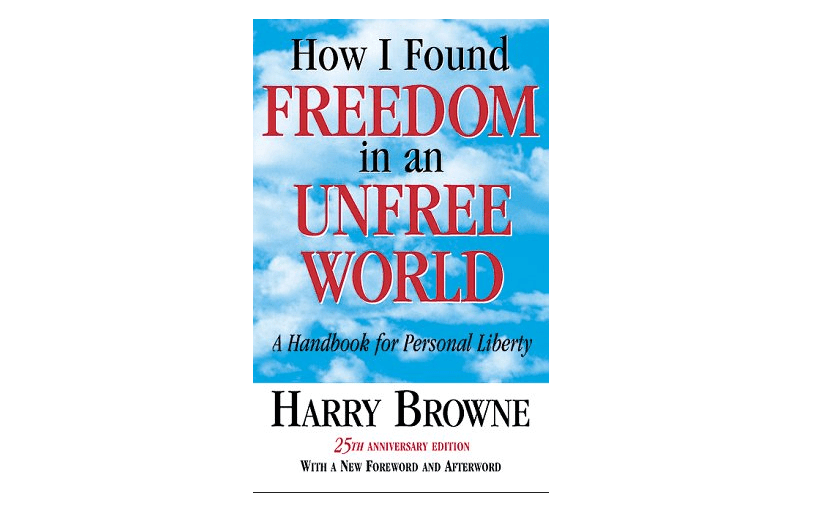
How I Found Freedom in an Unfree World
 ByStephen
What is How I Found Freedom in an Unfree World?
How I Found Freedom in an Unfree World (A Handbook for Personal Liberty) is one of the best non-fiction books I’ve ever read.
It was written by Harry Browne in 1973 and was a revolutionary book at the time – but not very widely read.
Harry Browne is an interesting man, who wrote a dozen books and ran for the Libertarian Party in the 1996 and 2000 presidential elections.
In How I Found Freedom in an Unfree World, Browne discusses the concept and importance of personal freedom, and how to achieve it.
Freedom, he says, is living your life the way you want to live.
This sounds obvious, but the vast majority of people do not have such freedom.
Me neither, at least not yet, but I am well on my way to achieving this – because I have made it a priority in my life.
Almost all of my life goals are centered on this and related to it in some way.
Check out my new book, available on Amazon!
Get the bookWhy are so few people free?
The first reason is that they are not aware of the existing alternatives.
They don’t realize that they can avoid social restrictions without becoming a hermit, that traditional marriage and its associated risks and problems are unnecessary, and that love is still possible.
They don’t see how they can become successful without having a traditional job, or how they can avoid paying taxes without going to jail.
And the second reason is that they have accepted social norms as being evident.
Norms that are not based on facts, but on externally imposed values and restrictions.
For example: “You must not be selfish”, “You must do your best to make the world a better place”, “Marriage requires sacrifice and compromise”, or “What you want is immoral”.
In this book, Browne not only shows how empty such concepts are, but also how you can live your life the way you want it.
By the way, it’s clear that a previous book I reviewed, The Unchained Man, got some heavy inspiration from How I Found Freedom in an Unfree World, and then expanded upon them, so check out that book too if you’re interested.
How I Found Freedom in an Unfree World summary
The premise of the book is that we live in an “unfree” world.
This is due to things we falsely assume to be true, and the circumstances in which we place ourselves (voluntarily, involuntarily, consciously and unconsciously).
Browne mainly focuses on the psychological changes you need to make, as well as lifestyle changes.
How I Found Freedom in an Unfree World is divided into 3 main parts: Why You Are Not Free, How to Become Free, and A New Life.
Why You Are Not Free
There are two big reasons why you are not free, according to this book.
You are either simply unaware of the many alternatives, or you have accepted certain restrictions on your freedom and take them for granted.
Gaining more personal freedom is therefore a simple matter of becoming aware of your options and removing the restrictions.
In the first 15 chapters, Browne lays out a lot of “traps,” reasons why people aren’t free.
- Identity Traps: The belief that you have to be someone other than yourself, and the belief that others do or see things as you would do or see them. You cannot control or direct the nature of others, you can only control how you deal with it.
- Intellectual Trap: You are in an intellectual trap if you use your “common sense” to determine your emotions and how you “should” feel. You think your emotions should fit some preconceived standard, not just who you are
- Emotional Trap: This describes the belief that you can make important decisions when you are emotional, such as getting married when you’re in love, or other “spontaneous” decisions that can have far-reaching consequences. You are in the emotional trap of letting your emotions dictate your decisions
- Morality Trap: Thinking you have to conform to someone else’s moral code, or that of society in general
- Unselfishness Trap: The belief that you must put the happiness of others before your own. Your personal happiness is the most important thing in your life
- Group trap: Believing that you can achieve more by sharing with others and involving them in your decisions and projects and the like, as opposed to just doing everything yourself
- Government Traps: Thinking that government performs socially useful functions that deserve your support, that you have a duty to follow laws, that you can rely on government to make some desired change, and fear that a government is so powerful that they can prevent you from being free
- Despair Trap: The premise that others can prevent you from being free
- Rights Trap: Believing that your “rights” give you freedom, and that they will get you what you want. Only the self-interest of persons can be used to get you what you want
- Utopia Trap: Thinking you must first create a better society before you can be free. Rest assured that you cannot determine the fate of a country. All you can do is make sure you are not negatively affected by it – something I’ve been emphasizing on this blog ad nauseam
- Burning-Issue Trap: Whenever you think there is a particular social cause that needs your help
- Previous-Investment Trap: The belief that you have to make today’s decisions taking into account the time, money and effort you have previously spent in the past
- Certainty Trap: Basically, thinking you know everything, and acting without considering the possibility that you are simply wrong
- Box Trap: Thinking that getting out of some unpleasant situation that restricts your freedom will cost you so much (in any way) that you would rather stay in your box (the shitty situation)
The latter in particular is a very interesting concept, and something I also discussed in my review of The Unchained Man.
A “box” is an unpleasant situation that restricts your freedom, but you are too afraid to escape from it.
A bad relationship/marriage, a shitty job, living in a Western country, and so on.
In many of those cases, you voluntarily stay in your box, fearing the cost of escaping it.
But… every day you stay in your box, you pay the price in terms of less freedom and happiness.
And… there is always a way out.
You will always have to pay a price for it, be it psychological, social, physical, monetary, …
That certainly won’t be pleasant, but it beats the daily price of staying in your box.
The faster you take the plunge, bite the bullet, the “cheaper” this will be.
Personally, I’ve already escaped three boxes, by working for myself, entering into a non-monogamous relationship, and moving to the other side of the world.
How You Can Become Free
Browne puts the blame entirely on yourself.
It’s your life, and you have the power to make it what you want.
If you want to be free, you must do it yourself.
Take action, make positive decisions.
Focus on what you can control, not what is beyond it.
- A positive decision is deciding between alternatives to maximize your happiness.
- A negative decision is deciding between alternatives to minimize your unhappiness.
A free person spends most of his time making positive decisions.
In this part of the book there are plenty of interesting topics, “tips and tricks” and rock solid advice to become a freer person.
Be true to yourself, be who you are, and don’t adjust to your environment. Adjusting to the expectations of others limits your freedom.
Who and how you are, is how you will find others who are just like you and who accept you for who you are.
If you pretend to be better or worse than you really are, you won’t find those people who are actually cut out for you.
Do you feel trapped by your parents, circle of friends, or relatives? Then it’s up to you to do something about it and cut ties.
It is important to always be honest, regardless of the consequences. Not only for your personal integrity, but it also shows others that they can trust you.
A Free Life
In the last part of How I found Freedom in an Unfree World, Harry Browne gives you his “rules” for living.
Think of these as suggestions, because in the spirit of the book, the author emphasizes that you must determine how you want to live your life.
- Never expect anyone to act from your perspective, knowledge, or goals. Always assume that his or her views will be different from yours
- Don’t make decisions when you’re emotional (I would strongly suggest you apply this to investing and setting up assets, as well as romantic issues)
- Don’t lie or try to pretend to be someone you aren’t
- Never invest money, time, or emotions in something you are not willing to lose
- Don’t take on any new responsibilities or commitments without carefully reviewing what you will lose (such as marriage or children)
- Always leave room in your calendar for unexpected opportunities
- Do not use someone else’s property in a way that would displease them
- Never focus your attention on someone else’s shortcomings. Acknowledge them, consider them, but don’t waste time complaining about them. It’s better to just focus on your actions to deal with them
- Don’t start complaining about extra (unexpected) costs. Don’t waste your time, just pay them and move on with your life
- Never form a partnership or a relationship where responsibilities and rewards will be shared
- Avoid violence at all costs, unless you really have no choice
- Stick to your personal code and rules, and certainly don’t change them because of the opinions or actions of others
Powerful words, and I can almost completely agree with them.
How I Found Freedom in an Unfree World is a wonderful book, and one that many people can get a lot out of.
Influential, motivating, radical.
Highly recommended, one of the best non-fiction books I’ve ever read.
Check out my new book, available on Amazon!
Get the book