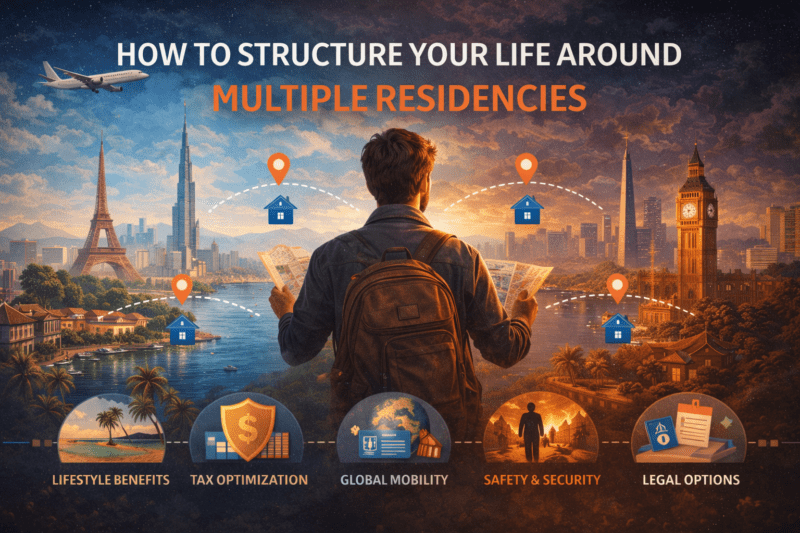
How to Structure Your Life Around Multiple Residencies
 ByStephen
Wise
- Up to 75% cheaper than banks
- Multi-currency card usable in 160+ countries
- 70%+ transfers arrive in under 20 seconds
TLDR
- Structuring your life around multiple residencies increases flexibility and reduces dependence on one country, tax system, or banking network.
- Most tax systems determine residency partly based on time spent in a country, often using a threshold of around 183 days in a year.
- Immigration rules such as the Schengen 90/180 rule limit how long you can stay in certain regions without residency.
- A practical multi residency setup usually includes a main base, one or two secondary residencies, and a clear travel calendar.
- The key to making it work is organization: track days carefully, maintain legal status in each country, and keep your financial life internationally structured.
There was a time when the idea of living across multiple countries sounded like something reserved for diplomats or retired billionaires. That world has changed dramatically over the last decade.
Today, entrepreneurs, consultants, investors, and remote workers increasingly structure their lives around more than one legal home. Not as a lifestyle gimmick, but as a strategy.
It’s something I’ve been talking about for years, and thus something I have quite a bit of experience with as well.
If you follow the broader theme of escaping the West and creating more personal freedom, multiple residencies become a logical next step. Instead of tying your entire life to a single jurisdiction, you spread it across several.
The result is optionality, redundancy, choice, freedom and flexibility. If one country changes its tax rules, political climate, or visa policies, you already have alternatives in place.
But building that structure requires some planning. It is not just about collecting residence permits. It is about designing a life that actually works across borders.
Understanding the Difference Between Residency and Citizenship
Before diving into strategy, it helps to clarify something many people confuse: residency and citizenship are not the same thing.
Citizenship gives you a passport and permanent membership in a country. It can also come with many obligations, such as voting.
Residency is simply the legal right to live there for a certain period of time.
Some residencies are temporary and tied to visas or permits. Others can become permanent after several years.
For the purpose of building a multi country lifestyle, residency is usually far more practical than chasing additional passports. Many countries offer residence permits through employment, entrepreneurship, retirement visas, or investment programs.
These permits allow you to legally stay, open bank accounts, rent property, and establish a presence without needing full citizenship.
For most globally mobile people, two or three residencies already create plenty of flexibility.
The Role of Tax Residency
One of the most important factors in a multi residency setup is tax residency. This determines where governments consider you a taxpayer.
Many countries use some variation of the same principle: physical presence. A commonly used threshold is 183 days in a year. If you spend more than half the year in a country, it may classify you as a tax resident.
That does not automatically mean you owe tax there, but it often triggers reporting obligations and potential liability.
Some countries apply additional tests, such as where your main home is located or where your economic interests are centered.
This is why serious international planners track their days carefully. Spending time across several jurisdictions can prevent accidental tax residency where you do not want it, or, even worse, double taxation.
It sounds complicated at first, but in practice it simply requires awareness and a calendar.
Immigration Rules That Shape Your Movement
Even with multiple residencies, you still need to understand immigration limits.
A well known example is the Schengen travel rule in Europe. Visitors who do not hold residency in a Schengen country can only stay up to 90 days within any 180 day period across the entire area.
This rule applies across dozens of European countries as a combined zone, not individually.
For people structuring a multi country lifestyle, this means you cannot simply bounce around indefinitely as a tourist. At some point, legal residency becomes necessary if you want longer stays.
Many countries in Asia and Latin America have similar frameworks. Tourist visas often allow stays between one and three months, while residence permits provide longer term stability.
Understanding these rules early helps you design a travel pattern that stays compliant.
Designing Your Core Base
A common mistake is trying to build a multi residency life without a real Base. That usually leads to logistical chaos.
In practice, most people operate with one primary country where they spend the largest portion of their time. This becomes the anchor of the system.
Your base is where you might rent a long term apartment, maintain local services, and establish daily routines.
For many location independent professionals, this base is chosen for quality of life and affordability rather than status.
Cities in Southeast Asia and parts of Latin America have become popular choices because they combine reasonable living costs with modern infrastructure.
You get all the benefits of modern, 21st century living, without all the massive downsides of a collapsing, Western world.
Once that anchor exists, the rest of the structure becomes easier to build around it.
Adding Secondary Residencies
The next layer usually consists of one or two additional residencies in different regions.
These serve several purposes.
- First, they provide geographic flexibility. If visa policies change in one region, you have another place where you are legally established.
- Second, they create redundancy in financial infrastructure. Opening accounts or conducting business can sometimes be easier when you have multiple jurisdictions available.
- Third, they allow seasonal movement.
Many people structure their year in simple patterns. For example, several months in Southeast Asia, part of the year in Latin America, and occasional time in Europe or their country of origin.
Once you have legal residency in more than one place, this movement becomes far smoother.
As a personal note, for the next phase of my life, this is something I’m going to focus on much more. Instead of staying in one Southeast Asian country 90% of the time, I’m going to be adding a Latin American base soon.
Organizing the Practical Details
The difference between a smooth international life as a digital nomad and constant administrative stress comes down to organization.
A few habits make a massive difference.
- First, track your travel days. A simple spreadsheet or calendar works fine. Knowing exactly how many days you spend in each jurisdiction prevents immigration and tax surprises later.
- Second, keep documentation organized. Residence permits, visa renewals, rental contracts, and bank statements should all be easy to access.
- Third, separate your financial structure from any single country. International bank accounts, diversified brokerage access, and digital payment systems help reduce dependence on one financial system.
This may sound technical, but once set up it runs quietly in the background.
Building a Life That Actually Works
One lesson that becomes obvious after spending time around globally mobile people and being one for over a decade, is that the most successful setups are surprisingly simple.
Three locations is often the sweet spot.
- One base where daily life happens.
- One secondary residency that provides strategic flexibility.
- And a third location that serves either as a seasonal destination or backup option. In today’s crazy world, you NEED a backup.
Anything beyond that can become administratively heavy, and I wouldn’t recommend it for 99% of people. 1 is stupid, 2 is sufficient, 3 is plenty.
In fact, going beyond 3 is not even that interesting for me at this point.
Personally, the most practical setups I have seen are the ones that focus less on collecting countries and more on building routines. Familiar cafes, trusted service providers, and stable housing make a huge difference when living internationally.
In other words, structure matters more than novelty.
Conclusion
Structuring your life around multiple residencies is not about constant movement or chasing exotic visas. It is about building resilience into your personal system.
Being protected, no matter what happens.
When your legal status, banking, and daily life exist across several jurisdictions, you are no longer dependent on a single country’s political or economic direction.
The approach requires some planning. Understanding tax residency rules, immigration limits, and administrative logistics is essential.
But once the framework is in place, the benefits become obvious. More mobility. More optionality. More control over where and how you live.
No more relying on deteriorating Western nations.
For people thinking long term about geographic flexibility, multiple residencies are one of the most practical tools available.