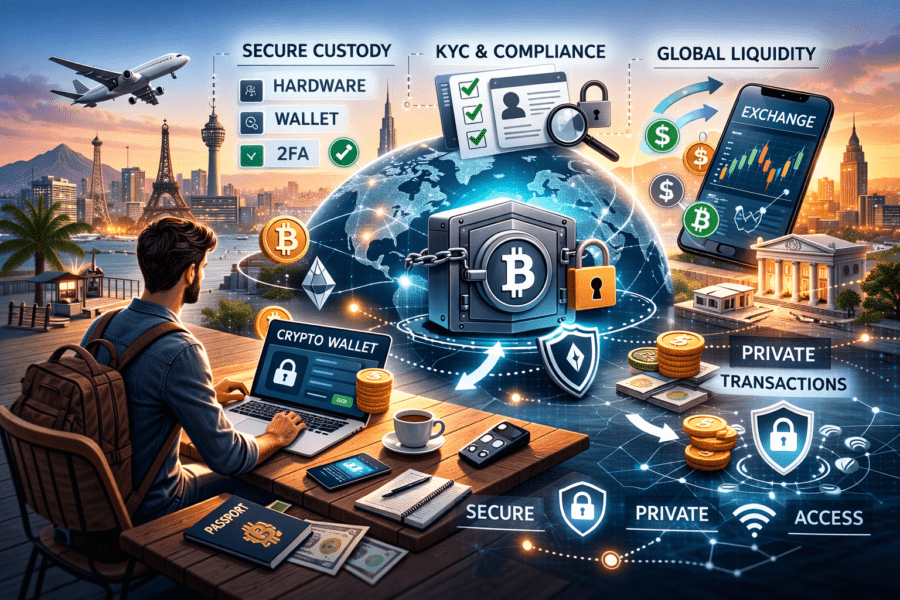
How to Use Crypto Safely When Living Abroad (Custody, KYC, Liquidity)
TLDR
- Use self custody with a hardware wallet for long term holdings and keep only working capital on exchanges.
- Complete KYC properly and understand how rules differ in your country of residence.
- Prioritize exchanges with strong liquidity so you can move between crypto and fiat quickly.
- Protect your devices, seed phrases, and two factor authentication at all times.
- Treat crypto as part of a broader international strategy, not a replacement for planning.
Living abroad changes how you think about money. Your banking system shifts, your tax exposure shifts, and your legal environment shifts. If crypto is part of your strategy, you cannot treat it casually anymore.
When you are operating across borders, crypto becomes both more powerful and more fragile. Powerful because it is portable. Fragile because compliance rules, exchange policies, and security risks multiply once you leave your home jurisdiction.
If you approach it deliberately, crypto can strengthen your optionality. If you approach it loosely, it can become a liability. Let’s walk through the three pillars that matter most: custody, KYC, and liquidity.
Custody: Who Actually Controls Your Assets?
At its core, crypto security comes down to one question: who controls the private keys?
You either control them yourself, or someone else does. There is no middle ground.
Self Custody: Real Ownership
Self custody means you hold your own private keys, usually through a hardware wallet. Hardware wallets store keys offline and protect them from online attacks. For anyone living internationally, this is a foundational tool.
If you move countries and an exchange decides it no longer serves residents in your new location, your self custody wallet is unaffected. No one can freeze it because of a change in address.
That said, self custody requires discipline.
You must:
- Secure your seed phrase offline
- Never store recovery phrases digitally
- Avoid accessing wallets on public Wi Fi
- Use hardware based two factor authentication where possible
I have personally seen people become overly confident after moving abroad. They relax because they feel financially independent. Then they lose a seed phrase or fall for a phishing email. The problem is rarely the blockchain. It is almost always user error.
Self custody gives you sovereignty. It also gives you responsibility.
Custodial Platforms: When Convenience and Liquidity Matter
Even the most hardcore self custody advocates usually keep some funds on exchanges. Why? Liquidity and convenience.
Reputable exchanges operate under regulatory frameworks and are required to segregate customer assets from operational funds. Many also maintain structured custody systems and security controls that are audited and monitored.
However, exchanges can freeze accounts if KYC requirements are not met, if your residency changes, or if compliance rules shift. This is not theoretical. In recent years, multiple jurisdictions have tightened crypto compliance requirements, requiring more detailed verification including biometric checks and geo confirmation during onboarding.
If you rely entirely on custodial platforms while living abroad, you are exposed to policy risk.
The balanced approach is simple:
- Long term holdings in self custody
- Active trading or spending funds on a compliant, high liquidity exchange
That way you never depend on one system alone.
KYC: Compliance Is Not Optional
Many people who move abroad imagine crypto as an escape from bureaucracy. That mindset is outdated.
Most established exchanges require full KYC verification. That typically includes:
- Government issued identification
- Proof of address
- In some cases biometric confirmation
- Ongoing monitoring of transactions
When you change residency, you must update your information. If you do not, your account can be restricted.
This becomes especially important if you relocate to Asia or Latin America. Some exchanges operate globally but restrict services in specific countries due to local regulation. Others require you to use region specific platforms depending on your residence.
Before you relocate, check:
- Whether your preferred exchange legally operates in your destination country
- Whether your new country has specific crypto reporting obligations
- Whether using foreign exchanges is permitted or restricted
In some jurisdictions, crypto exchanges must be registered locally to serve residents. In others, access is allowed but monitored more closely. Ignoring this can result in frozen withdrawals at the worst possible time.
Crypto is traceable. Regulators know this. Acting as if it is invisible money is naive.
The smart approach is compliance plus diversification. Maintain verified accounts in more than one jurisdictionally stable exchange if possible. That way, if one relationship becomes complicated, you are not cornered.
Liquidity: Can You Actually Use Your Crypto?
Security is meaningless if you cannot access your funds when needed.
Liquidity refers to how easily you can convert crypto into fiat or another digital asset without large price spreads or delays.
For someone living abroad, liquidity matters for practical reasons:
- Paying rent
- Covering visa fees
- Booking flights
- Handling emergencies
Choose exchanges with deep trading volume and established banking relationships. Higher volume generally means tighter spreads and smoother execution.
Also pay attention to fiat on and off ramps. Some exchanges offer excellent crypto liquidity but limited local banking integration in certain countries. That creates friction when converting into local currency.
If you are living in a country where crypto adoption is still developing, test small transactions first. Do not wait until you urgently need funds to discover withdrawal timelines or bank transfer limitations.
In my own experience, doing a small withdrawal test immediately after relocating has saved stress later. It is a simple habit that reveals practical realities quickly.
Operational Security Abroad
Living internationally introduces physical and digital risks that people underestimate.
You might be in coworking spaces. You might rely on hotel Wi Fi. You might travel frequently.
Protect yourself with basic but strict habits:
- Never access exchange accounts on unsecured public networks
- Use hardware based two factor authentication instead of SMS
- Keep devices updated
- Separate daily use devices from those used for large transactions
If you carry a hardware wallet while traveling, think about physical security as well. Some people store seed phrase backups in a separate country from their main residence. Others use secure storage solutions locally.
There is no universal setup. The key is redundancy without exposure.
Regulatory Awareness: Stay Ahead of Shifts
Crypto regulation continues to evolve. In 2024 and 2025, multiple regions implemented clearer frameworks for crypto service providers, including licensing requirements and stricter compliance standards.
These frameworks aim to reduce fraud and increase transparency. For you, that means exchanges may periodically request updated documentation or restrict certain services depending on your location.
Instead of reacting emotionally, build this into your strategy. Regulations that strengthen custody standards and segregation of assets can actually reduce counterparty risk when using reputable platforms.
The mistake is assuming yesterday’s rules will apply tomorrow.
Set a quarterly reminder to review:
- Whether your exchanges remain licensed in your jurisdiction
- Whether new reporting obligations apply
- Whether banking relationships used for withdrawals remain stable
This takes an hour at most and prevents major surprises.
Integrating Crypto Into a Broader Expat Strategy
Crypto should not be your only cross border asset. It should be part of a diversified structure that may include:
- Foreign bank accounts
- Multiple residencies
- Traditional brokerage accounts
- Physical assets
Crypto adds speed and portability. It does not replace structure.
When used properly, it reduces dependence on any single banking system. If one country tightens capital controls or your account faces delays, crypto can provide short term flexibility.
But flexibility only exists if custody is secure, compliance is current, and liquidity is reliable.
Conclusion
Using crypto safely while living abroad is not complicated. It simply requires maturity.
- Control your keys for long term holdings.
- Comply fully with KYC rules.
- Choose exchanges with real liquidity.
- Protect your operational security.
- Monitor regulatory developments calmly and consistently.
Do this, and crypto becomes a powerful component of your international life. It supports optionality instead of undermining it.
The goal is not rebellion. The goal is resilience.
Build your structure carefully, and you can move across borders without losing control of your financial foundation.