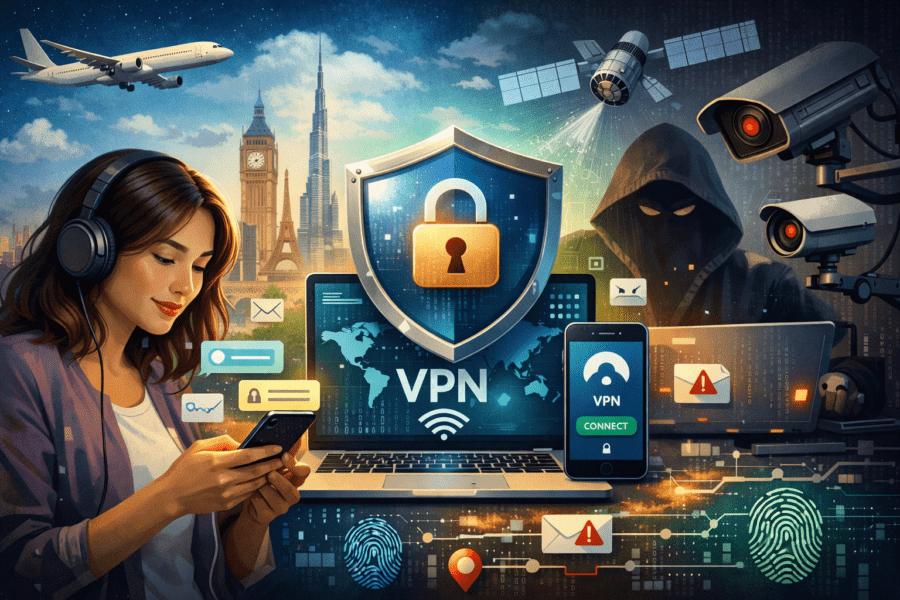
Digital Privacy for Expats: Safe Comms, VPNs, and Avoiding Surveillance
 ByStephen
NordVPN
- Over 7,000 servers in 110+ countries
- Built-in malware and ad blocking
- Connect up to 10 devices simultaneously
TLDR
- You need encrypted messaging and secure email to keep communications private from networks and platforms.
- A VPN protects internet traffic on public and private networks and helps avoid local monitoring.
- Online privacy laws and proposals in some regions aim to reduce encryption protections.
- Strong device and account practices protect against data harvesting and unauthorized access.
- Being aware of local internet policies where you live helps you choose the right privacy tools.
When you’re living abroad – especially outside the traditional Western sphere – a lot about your life becomes borderless. Your bank accounts might span several countries. You might be working remotely.
You talk to people back home. All of that means you’re interacting with digital systems that were never meant to be globally mobile.
Most of us grew up assuming our phones and messages were private. That’s not true anymore. Your data travels through networks, servers, and infrastructure that many authorities, companies, and hackers can monitor.
That includes internet service providers, app platforms, and sometimes even foreign governments.
For an expat, your online privacy isn’t just about avoiding ads. It’s about maintaining control over your communications, protecting your financial information, and avoiding surveillance in places where data protection laws are weaker or still evolving.
Here’s how to manage that clearly and practically.
Why You Need More Than Basic Security
Standard SMS text messages, email services without encryption, and many social platforms store or can access your communications. They often log metadata like who you contacted, when you did it, and where you were when you did it. That information can be as revealing as the content itself.
Once you’re living abroad and using public networks or local carriers, your data travels through systems with varying privacy protections. In some countries, there’s proactive monitoring of foreign communications.
In others, laws allow extensive data retention or even backdoors in encryption. Those are not abstract worries, they’re documented concerns in the global conversation on digital privacy.
So point one of your privacy strategy is to shift from tools that might protect you to tools that are designed to protect the content and the context of your communications.
Encrypted Messaging: Keep Conversations Between You and the Recipient
End-to-end encryption means that only the sender and the recipient can read the contents of a message. Even the service provider that handles the message can’t see it. When you’re on the move, this is essential for staying in touch without exposing conversations to intermediaries.
Some secure messaging apps use strong end-to-end encryption by default. That means the message content is only readable on the devices at either end of the conversation. This applies to text, voice messages, and calls.
Encrypted messaging protects against hackers on shared networks, local internet service monitoring, and corporate data harvesting.
Be aware that not all platforms offer end-to-end encryption by default. Some only apply it in “secret chat” modes or for certain message types. Always check whether a given app fully encrypts by default and whether it stores metadata such as contacts and timestamps.
Virtual Private Networks: Encrypt Your Internet Connection
A Virtual Private Network, or VPN, encrypts your entire internet connection. When you activate a VPN, all the data you send and receive is routed through an encrypted tunnel, so your internet service provider or anyone on the same network cannot see your activity.
For expats, using a VPN routinely provides several advantages:
You secure your internet traffic when you use public Wi-Fi in cafes, airports, or hotels.
You protect your location and browsing habits from local surveillance or network monitoring.
You keep sensitive information and login credentials from being intercepted on unsecured networks.
That last part matters because public Wi-Fi is a favorite target for hackers. Without a VPN, anyone on the same network could potentially intercept your data.
A VPN also masks your IP address so that services you log into see the VPN exit point instead of your real address. This controls location-based tracking and profiling.
Keep in mind that VPN legality varies. In most countries it’s legal to use a VPN for privacy. In some, it may be restricted or regulated. Always confirm the local stance where you live, and choose a service that operates from a privacy-friendly jurisdiction with no logs.
Devices and Secure Practices
Even with encrypted apps and a VPN, your device is often the weakest link.
Your phone, laptop, or tablet can be compromised in several ways:
- Malware introduced through unsecured downloads or phishing.
- Apps with excessive permissions that harvest data.
- Weak passwords or reused passwords across multiple accounts.
To mitigate these risks, get into the habit of:
- Using long, unique passwords stored in a reliable password manager.
- Enabling two-factor authentication on your most sensitive accounts.
- Avoiding public Wi-Fi for banking or work unless your VPN is active.
- Keeping your operating system and apps updated to protect against exploits.
These are not luxury habits. They are discipline measures that protect your privacy as soon as you go abroad.
Check Local Internet Regulation and Surveillance Policies
Where you live matters. Everywhere sucks, but not to the same degree.
Some countries (like China) have far more aggressive internet surveillance and censorship regimes than others. In certain jurisdictions, use of tools like VPNs or secure messaging apps can be legally restricted or blocked outright.
In a few places, unencrypted services are actively monitored. In others, authorities have pursued proposals to weaken encryption by requiring backdoors that let law enforcement access communication content.
That means you should research and regularly review:
- Local privacy laws and internet regulations.
- Whether secure communication tools are permitted or blocked.
- Whether websites or services you rely on are accessible.
Your choice of tools and configurations should always take into account where you are legally. That’s part of maintaining digital sovereignty.
Align Your Tools to Your Daily Use
Digital privacy should not just be theoretical. It should reflect how you use the internet every day.
If you’re doing online banking, communication with family, work conferencing, or accessing cloud services, you should assume that these interactions could be observed or logged without encryption.
This is why encrypted messaging and a reputable VPN are foundational tools.
However, privacy also includes habits:
- Review app permissions and remove those that are unnecessary.
- Avoid geotagging photos and sensitive data when posting online.
- Sign out of sensitive accounts after sessions on shared devices.
These habits reduce your digital footprint and potential tracking signals.
Integrate Privacy Into Your Routine
Building digital privacy into your life abroad is not a one-off setup. It’s an ongoing practice.
Every time you install a new app, log into a service in a new location, or connect to a network you haven’t used before, you expose yourself to potential risk.
If you treat digital privacy as a strategic part of your relocation planning – just like banking, visas, and local residency – you give yourself an advantage.
Encrypted communications, VPN protection, and careful device practices don’t just keep your personal information secure. They protect your financial information, your professional correspondence, and your personal autonomy.
Conclusion
Moving abroad means navigating not just new cultures and languages but also new digital landscapes. Some places will have robust privacy laws and protections. Others may actively surveil internet traffic. Your approach to digital privacy should match that reality.
Adopt secure communication tools that encrypt your messages end to end. Use a reputable VPN to secure internet connections, especially on public networks. Practice strong device hygiene and stay aware of evolving local rules and restrictions.
This is not about hiding from your life. It is about keeping control of it no matter where you choose to establish your base.
By planning and protecting your online privacy, you can travel, work, and connect with confidence.