Best Secondary Cities in Southeast Asia for Long-Term Living
 ByStephen
Wise
- Up to 75% cheaper than banks
- Multi-currency card usable in 160+ countries
- 70%+ transfers arrive in under 20 seconds
Key Take-Aways
- Secondary cities in Southeast Asia often offer lower living costs, less traffic and a more relaxed pace than major capitals.
- Places like Chiang Mai, Da Nang, and Davao City combine modern infrastructure with more traditional living.
- Many of these cities provide excellent healthcare, reliable internet, and long term visa options that make extended stays practical.
- Living outside the primary capitals can significantly reduce housing costs while improving your quality of life.
- Choosing the right secondary city depends on your climate preferences, visa access, healthcare quality, and international connectivity.
I’m a huge fan of Southeast Asia, something you might have picked up on when you’ve read a few of my articles or books.
This region is booming, provides a high quality of living at a discount price and has something for everyone.
But I’ve noticed during my conversations with (potential) travelers and research, that when people first consider relocating to Southeast Asia, they go for the “big names”: Bangkok, Singapore, Manila, Kuala Lumpur, Bali and Hanoi.
Those cities dominate travel blogs and relocation guides, and I can understand why – they’re the easiest to get to, have the largest expat communities and it’s usually hubs where things are happening in the country.
Personally though? I’ve visited most of the big cities in Southeast Asia and while they’re definitely worth checking out, they’re not exactly places you’d want to stay long-term, in my opinion.
Once you’ve spent some considerable time in the region (think 3+ months), you’ll realize that the best places to stay long term, aren’t the major capitals, the big names, at all.
Secondary or even tertiary cities across Southeast Asia often strike a better balance. They too have big airports, decent healthcare, and modern infrastructure, yet they avoid a lot of the chaos, traffic, and rising costs of the largest metropolitan hubs – not to mention the inevitable foreigner bloat.
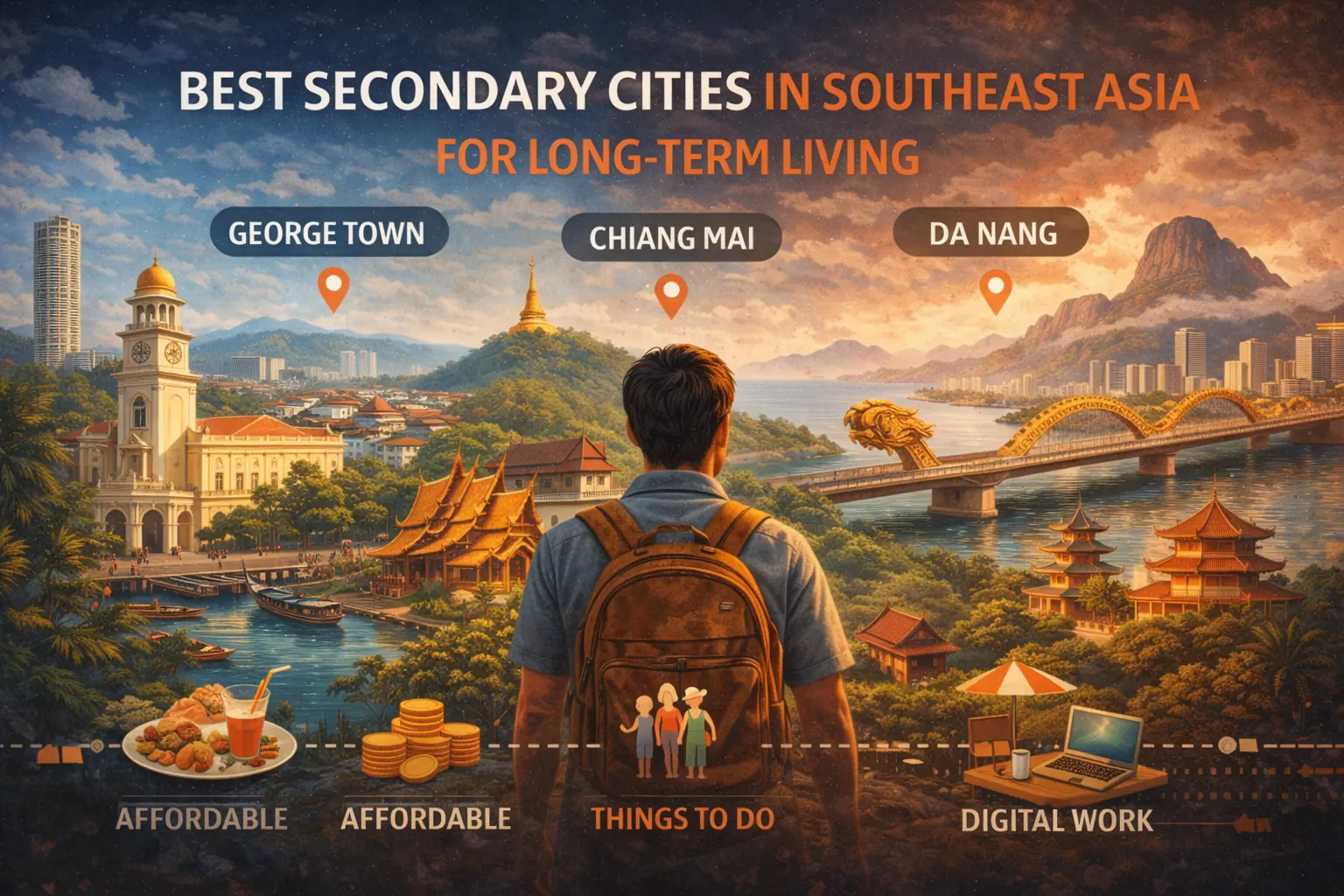
In this article, I’ve compiled a list of the best secondary cities in Southeast Asia for long-term living. Of course, what’s the best option for you will depend heavily on what you want!
I’ve been living in a secondary city in Southeast Asia for the past 10 years now and I love it, we’ll talk about that later.
Chiang Mai, Thailand
Chiang Mai has been on the radar of international residents for more than a decade, and it remains one of the most practical secondary cities in Southeast Asia, and one of the most expat friendly secondary cities.
It’s located in northern Thailand and combines a relatively low cost of living with strong infrastructure. Internet connectivity is reliable, coworking spaces are widely available, and the international airport provides direct connections across Asia.
In Thailand small cities are often ranked as the most affordable cities in Southeast Asia, and while Chiang Mai has seen an increase in cost of living, it’s still leagues better than any Western city.
Healthcare is another factor that keeps drawing people in. Chiang Mai hosts several private hospitals that attract international patients, offering modern facilities and English speaking staff.
Want some plastic surgery? Some new boobs for your girlfriend or boyfriend? Chiang Mai has it all.
Day to day life is pretty comfortable without feeling overwhelming – if you can manage the heat, but of course that can be said about almost everywhere in Southeast Asia.
You can still find quiet neighborhoods, tree lined streets, and markets where daily errands feel simple rather than stressful.
Da Nang, Vietnam
If you’re considering long-term living in Vietnam cities, then Da Nang has to be considered.
It was once a relatively modest coastal city, but gradually, over the course of a few decades, it now sits at the center of Vietnam’s rapidly developing central region.
The first thing you’ll notice here is the impressive coastline. Da Nang stretches along a long strip of sandy beach, and residential areas near the water have grown steadily as both locals and foreigners move in.
Infrastructure development has been significant in most secondary cities Southeast Asia, and that’s nowhere more visible than here in Da Nang. The city now has a modern international airport, large bridges connecting different districts, and expanding commercial areas.
Living costs remain lower than in Vietnam’s largest cities. Housing in particular is often more affordable compared to Ho Chi Minh City or Hanoi, especially for modern apartments near the coast.
Also, and this is the most important for me: there is also a relaxed pace to the city. Traffic exists, of course (it’s still Vietnam), but the overall environment feels more manageable than Vietnam’s largest urban centers.
Cebu City and Davao City, Philippines
I love the Philippines. It’s where I chose to go for the past decade, and for good reason.
Cebu City is one of the Philippines’ most important regional centers. It sits outside the national capital region but still plays a major role in the country’s economy.
One of the biggest advantages here is connectivity. Cebu’s international airport serves as a major gateway to both domestic destinations and several international routes across Asia. There are plenty of direct flights to, say, Singapore, Kuala Lumpur, Hong Kong, and so on.
The city has developed rapidly over the past decade. Shopping malls, residential towers, and business districts have expanded significantly.
English is widely spoken throughout the Philippines, which makes everyday life straightforward for foreign residents (this was one of the major perks that made me drift to PH).
Administrative tasks, banking, and healthcare interactions tend to be easier than in places where language barriers are stronger.
Cebu also provides access to some of the country’s most beautiful islands. Weekend trips to nearby beaches are common among residents. I’d personally recommend Bantayan (skydiving!) and Malapascua (SCUBA diving!).
Now, that being said, while I’d certainly recommend Cebu to most people, I personally chose Davao City, the country’s 3rd main city, all the way down.
It used to be way less popular with foreigners than Manila and Cebu. During my first 6 months there, I saw one other foreigner. ONE. Now? They’re everywhere.
If you really want an expat community, Davao City is now a place you can find it.
In addition, while the cost of living has increased markedly since COVID and the new government (never thought I’d long for the days of Duterte), it’s still extremely cheap to live here. Currently, the peso is very weak, which means your euro and dollar go much further – roughly 20% more than a few years ago.
Davao has modern healthcare, easy transportation, proximity to beautiful islands, many outstanding malls, good gyms, excellent food, a convenient immigration office, etc.
BIG TANGENT, PERSONAL NOTE: It also has an international airport which usually isn’t busy at all, yet still provides direct flights to Singapore and across the country. I really love Davao’s airport – in over a decade and many dozens of flights going from and arriving there, I’ve never had ANY hassle whatsoever.
They don’t make you take off your goddamn shoes, the layout is simple, they’re pretty relaxed about most things. I usually travel with only hand-luggage, which means that after deplaning, I’m out of the airport within 3 to 5 minutes at most. And when you exit, the longest I’ve had to wait for a taxi was roughly 10 minutes, and that’s rare – usually you can hop into an air-conditioned taxi after a few minutes in line. It’s super convenient AND super safe, no risk of getting scammed here at all… only metered taxis are allowed, they write down your name and the license plate of the taxi when you leave and give you a small paper so you can complain if needed. Needless to say, it’s never been needed, because they’re always on their best behaviour. As opposed to other airports in Southeast Asia AND in the Philippines, where taxi-scams are a plague, Davao has eliminated this crap by not taking any.
That brings me to another reason I love Davao: it’s very safe. It’s the place I’ve decided to raise a family in, and that’s a big deal for me. I’ve also invested in real estate here.
Anyway, I could go on and on about the benefits of this place, but there’s a reason that my services include assistance with moving to Davao and buying real estate here. 100% recommended.
Penang, Malaysia
Penang is a rather unique place in Southeast Asia.
It combines historical architecture, strong food culture, and reliable infrastructure in a way that feels surprisingly livable long term.
Malaysia has long attracted international residents due to its relatively accessible long stay visa programs, well developed healthcare system, and the rather high levels of English. Penang benefits from all of these advantages.
The island also hosts several well known private hospitals that draw international patients. Healthcare access is a major reason some expat retirees choose the area.
Daily life tends to revolve around walkable neighborhoods, local markets, and food stalls that are deeply embedded in Penang’s cultural identity.
For someone seeking a base that feels international yet grounded in local culture, Penang often ranks high on the list.
Yogyakarta, Indonesia
Indonesia has been on my list-to-live for many a decade, ever since reading some book when I was a child.
As such, I’ve considered several Indonesia mid-size cities as a place to live in, and that’s how I stumbled upon Yogyakarta (Jogja), which lies in Java.
Yogyakarta offers something quite different from the other cities on this list. It is known primarily as a cultural and educational center.
The city hosts several major universities and maintains a strong reputation for traditional arts, music, and crafts. That academic environment gives Yogyakarta a youthful energy that many expats notice quickly.
Living costs remain relatively low compared to Jakarta or Bali. Housing, food, and transportation can be very affordable by international standards.
Another advantage is location. Yogyakarta sits near several well known cultural landmarks, including ancient temple complexes that attract visitors from around the world.
For someone looking for a slower, culturally rich environment rather than a high rise urban center, Yogyakarta can be an appealing base, and it would definitely be where I’d set up camp if I ever moved to Indonesia long-term.
What to Look for Before Choosing a City
When it comes to excellent secondary cities Southeast Asia has so much to offer, but of course, I would strongly recommend you pay attention to a few practical factors before making your move.
Visa options are one of the first things to check. Each country in Southeast Asia has its own residency and long stay frameworks, and the details can change over time.
For example, one of the noticeable downsides of the Philippines for me is the lack of a long-term residency option – but that will change once I get older (43-45).
Healthcare access is another critical factor. Cities with established private hospitals and international clinics usually offer a smoother experience for foreign residents.
Connectivity also matters more than ever, especially for us digital nomads. Reliable internet, accessible airports, and stable infrastructure make a big difference once you start running a location independent lifestyle.
Finally, climate preferences should not be ignored. Tropical environments can vary significantly between coastal areas, highland regions, and inland cities.
Conclusion
In summation, Southeast Asia offers an enormous range of living environments, and the region’s secondary cities often deliver the most balanced lifestyle.
When it comes to the best cities Southeast Asia, I’d recommend places like Chiang Mai, Da Nang, Penang, Cebu City/Davao City, and Yogyakarta.
They combine affordability, infrastructure, and “liveability” in ways that larger capitals more than ever struggle to maintain.
For anyone escaping the West and exploring long term relocation in the region, it is worth looking beyond the obvious destinations.
The places that initially receive less attention often turn out to be the ones where people quietly build comfortable lives – like I did.
If you’re interested in moving to Davao City or want to invest here, get in touch and let’s talk!