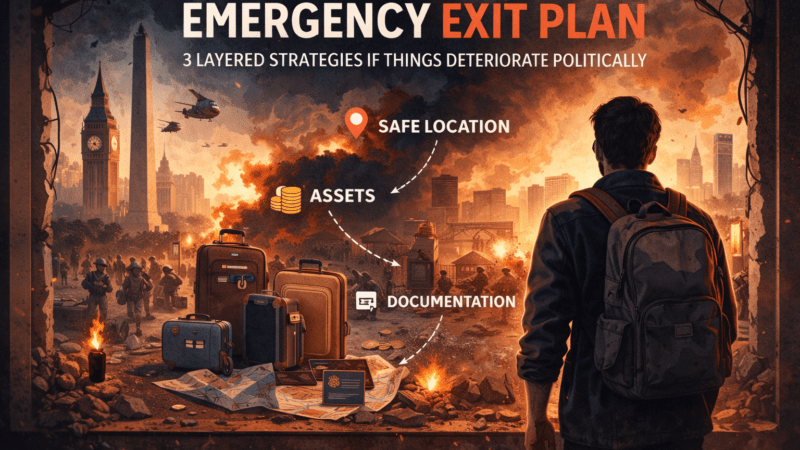
2026 Is the Year the West Collapses
Welcome to the end of the Western world.
2026 will be the year the collapse becomes obvious to the majority of people still living inside it. Not because everything suddenly explodes overnight, but because the accumulated rot finally reaches a point where denial is no longer possible.
This is the year where deterioration stops being abstract and starts being felt everywhere: socially, economically, politically, psychologically.
I’ve been writing about this for years. The slow decline, the structural weakness, the false sense of stability. But over the past year, something has clearly shifted. What used to be a gradual slide has gone into a much higher gear. The system is no longer merely decaying, it’s destabilizing and ready to crack.
The Current State of the West
Look at the status quo.
Trump’s second administration has been volatile, divisive, and relentlessly chaotic. Bombings, kidnappings, alienation of long-standing allies, casual threats to international agreements that have held the post-war world together for decades. Actions that, just a few years ago, would have been considered unthinkable are now treated as Tuesday news cycles.
Kidnapping the president of another nation (regardless of how despicable that leader might be, and I’m definitely not a fan of his) crosses a line. It’s not about morality, it’s about precedent. Once a line like that is crossed, it becomes infinitely easier to cross again. The same applies to openly threatening to seize Greenland by force from an ally. That isn’t good statesmanship, it’s lunacy.
Meanwhile, in Europe, EU member states are slowly coming to terms with an uncomfortable reality: they are powerless, incompetent and relatively pointless. Powerless to stop Russia. Powerless to restrain the United States. Powerless to meaningfully influence the geopolitical forces shaping their future. This helplessness only feeds further resentment and discontent in societies that are already deeply divided, anxious, and angry.
The UK is sliding openly into authoritarian territory. Arrests for jokes, “hate speech,” and thinking the wrong way are now normalized. State propaganda is openly pushed. Citizens are instructed on how they should think and speak, all while millions of mostly unemployable young men from 3rd world countries are imported en masse, housed at taxpayer expense, and given allowances in a country that can barely support its own working population.
Across the Atlantic, the United States is reaching a new level of internal tension. Nationwide ICE raids collide with ideological resistance, leading to violence, riots, and organized obstruction of law enforcement. The result is predictable: chaos, criminality, and further erosion of trust in institutions.
And then there’s the Minnesota fraud scandal, a billion-dollar scam involving Somali immigrants, fake daycares and healthcare centers siphoning public money. The truly insane part isn’t just the scale of the fraud, but the reaction: the population is split on whether this is even a problem.
The governor (who almost certainly seems complicit to some degree) appears to side with the perpetrators rather than the taxpayers. Something as basic as “we should not allow people to steal from the public, and especially not (potentially illegal) immigrants who use this money to live lives of luxury, buy property in Africa and even fund international terrorism” has become a partisan issue. That alone tells you how far gone things are.
Add to this the broader pressures grinding the West down:
- AI-driven job destruction displacing millions, with no viable plan for reintegration
- Exploding crime rates
- Ever-increasing tax burdens
- Crushing cost-of-living increases
- A mental health crisis of historic proportions
None of these issues exist in isolation. They compound. They reinforce each other. And they accelerate the collapse.
The Historical Pattern No One Wants to Acknowledge
Empires don’t last forever.
Historically, the average lifespan of an empire is roughly 250 years, or about ten generations. I’ve gone into this in detail in this article, but what you need to know is that this pattern is remarkably consistent across human history.
The United States (the core power underpinning the entire Western system) celebrates its 250th anniversary this year, since they gained independence in 1776.
No, this doesn’t mean the American empire collapses precisely on its 250th birthday. But statistically, historically, this is the inflection point. The moment where internal contradictions overwhelm cohesion. Where decay overtakes renewal. Where collapse becomes far more likely than recovery.
Every year leading up to now has been building toward this moment. In that sense, the decline is overdue. And when the U.S. finally tips, the ripple effects will be immediate and severe: economic shockwaves, political fragmentation, social unrest, and cascading instability across Europe and the wider Western sphere.
What Happens Next?
I don’t claim to know exactly how this plays out.
Could the West miraculously pull itself together? Could new leadership, reform, or technology restore stability and even usher in a new golden age? Maybe in theory, yes.
But theory isn’t reality.
I’m not a dreamer. I’m a realist. And from where I’m standing, the writing is on the wall. We’re approaching critical mass, a point where one or two shocks could trigger a rapid collapse instead of the slow decline we’ve been watching for decades.
What form that collapse takes, how fast it unfolds, and what the immediate triggers are, nobody knows. But that it will happen, and that it’s approaching fast, is no longer a fringe idea. The data, the demographics, the debt, the social fragmentation and the institutional decay all point in the same direction.
Am I wrong? Possibly. You can argue that emotionally. But rationally? The facts don’t support optimism, the facts point towards an inevitable collapse within our lifetime.
2026 seems as good (or as bad) a year as any.
What You Can Actually Do About It
Here’s the part most people don’t want to hear.
You cannot stop this. Not by voting. Not by protesting. Not by violently opposing police. Not by calling people racist. Not by arguing on social media. That ship sailed decades ago. And even if it hadn’t, fixing a civilizational collapse through politics would still be an indirect, low-probability solution.
The only viable option is what Harry Browne called a direct solution.
You take personal responsibility. You take control of your life, your finances, your geography. You remove yourself from the collapsing system and build a life somewhere else.
I did exactly that a decade ago. Leaving the West was the best decision I’ve ever made. Life in Asia has been outstanding: safer, cheaper, , happier, more human. Judging by the sheer number of foreigners now pouring into my city, I’m far from alone in that assessment.
Later this year, I’ll enter the next phase: moving to Latin America. And while I’m excited about the lifestyle, the economies, and yes, the women, the best part is something else entirely.
The collapse of the West will barely touch me.
Civil war in the U.S.? A massive depression? The EU fracturing? A real war with Russia? Any of these scenarios could unfold, and none of them would materially threaten my life or finances.
You can do the same.
You can remove yourself from the blast radius. You can build a life that is freer, saner, and more resilient. But time is not on your side anymore.
If you’re going to act, you need to do it now, and you need to act decisively.
The window is closing, faster than even I thought it would.