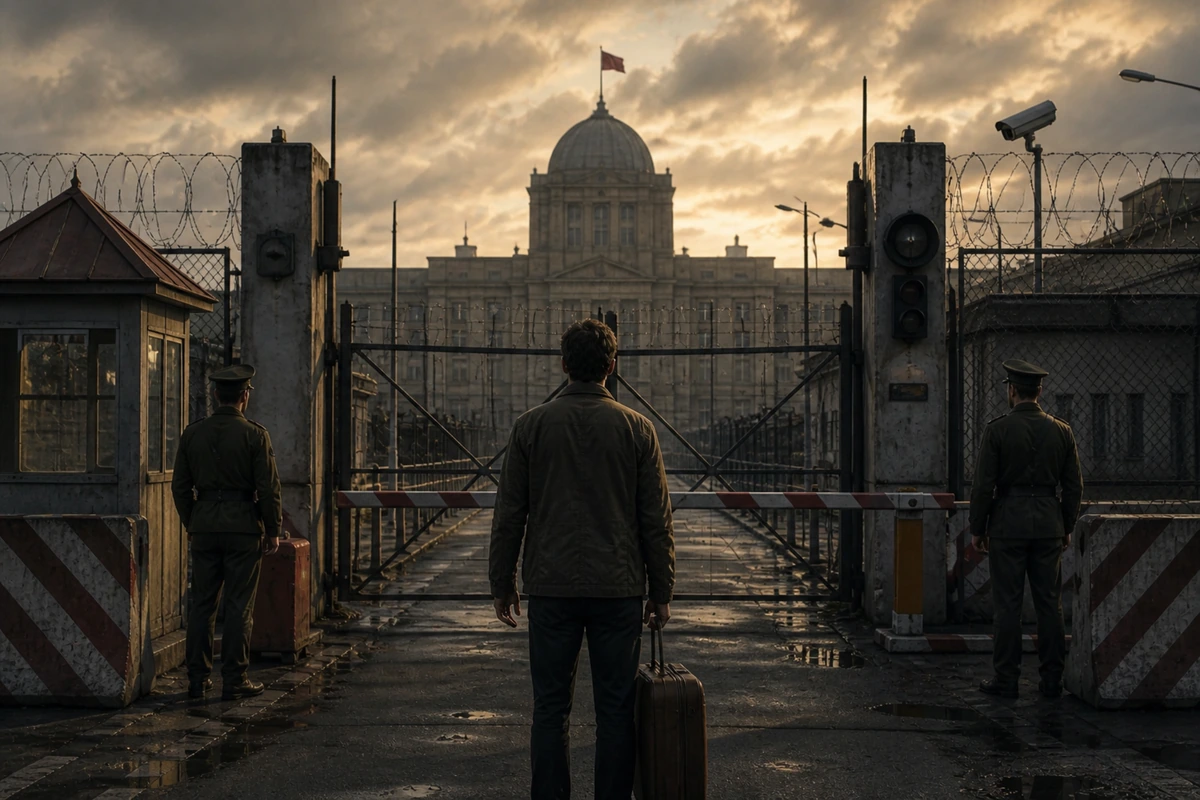
🛡️When Governments Tighten Exit Rules: Historical Case Studies

TLDR
- Control Tactics: Governments use capital controls, travel limits, and administrative barriers to restrict exit during crises.
- Economic Triggers: High debt, currency pressure, and political instability are the primary drivers of historical exit restrictions.
- Global Patterns: From Argentina to Greece, restrictions often follow a predictable path: banking limits, then currency shortages, then full lockdowns.
- Early Warning Signs: Watch for increased transaction scrutiny, withdrawal limits, and “temporary” emergency regulations.
- Proactive Defense: Preparation requires jurisdiction diversification, including multiple residencies and offshore accounts.
You do not usually wake up one morning and find the doors closed. It is rarely that dramatic. What actually happens is slower, more procedural, and almost boring on the surface. A new regulation here, a “temporary” limit there. Then one day you realize moving money, or even yourself, just got complicated.
If you are building a life with optionality, understanding how and why governments tighten exit rules is not theoretical. It is practical. And history gives you more than enough examples to work with.
At the core, it is about control. When a country faces pressure, whether financial or political, capital and people tend to leave. That outflow can accelerate instability. Governments respond by trying to slow or stop that movement. Not because they want to, necessarily, but because they feel they have to.
Currency reserves drop, banks weaken, and confidence erodes. Limiting exit becomes a defensive move. You will notice a pattern across different countries and decades. Restrictions tend to show up during moments of stress, not stability. That alone tells you when to start paying attention.
📊 Why Governments Pull the Plug
| Reason | Objective | Method |
| Capital Flight | Stop the bleeding of hard currency | Transaction limits and “exit taxes” |
| Brain Drain | Retain skilled labor and taxpayers | Passport delays or historical exit restrictions |
| Debt Crisis | Force citizens to fund the government | Mandatory bond purchases or “bail-ins” |
| Social Control | Prevent political opposition from organizing | Travel bans and government travel restrictions |
🇦🇷 Argentina: A Repeating Cycle of Financial Barriers
Argentina is probably one of the clearest modern examples. Over the past decades, the country has repeatedly introduced capital controls during economic downturns. In 2011, strict foreign currency controls were introduced to limit access to US dollars.
Individuals faced limits on how much foreign currency they could purchase, and companies had to justify transactions abroad. These controls were later eased, then reintroduced again in 2019 when financial pressure returned. It was not a one-time event; it became part of the cycle.
If you were living there without offshore access, your financial flexibility would have been directly tied to policy shifts. This is why many Argentines have become experts in using crypto safely. When the local bank won’t let you withdraw your savings, or forces you to convert them at a fraudulent official rate, having stateless assets is the only way to survive.
💡 Argentine Financial “Red Flags”
- The “Blue Dollar” Rate: When a massive gap opens between the official and black market exchange rates.
- Justification of Funds: Being forced to provide dozens of documents for even small transfers.
- Temporary Freezes: Short-term “holidays” where you cannot access accounts.
🇬🇷 Greece: Banking Limits Inside the Eurozone
Greece in 2015 caught a lot of people off guard, especially because it was inside the Eurozone. Many assumed that meant a higher level of stability and freedom of movement.
When the debt crisis escalated, banks were temporarily closed, and capital controls were introduced. Withdrawals were limited to a fixed daily amount, and transfers abroad required approval. It was not just about large investors. Ordinary people could not freely access their own money.
Businesses struggled to pay international suppliers, and the economy ground to a halt. Even within a developed monetary union, past travel bans on capital can happen if the system is under enough pressure. If you had not already set up a second bank account abroad, you were stuck in the queue with everyone else, hoping the bank would open on Monday.
Expert Tip! Always maintain a “travel fund” of hard cash and a foreign debit card that is not linked to your primary residence’s banking system. This ensures you can still buy a plane ticket when local cards are declined.
🇨🇾 Cyprus: The “Bail-In” and Sudden Lockdowns
Cyprus in 2013 introduced something that many had not seriously considered before: deposit haircuts. Large bank deposits were partially converted into equity to stabilize the banking system. At the same time, capital controls were imposed. Transfers abroad were restricted, and withdrawal limits were introduced.
This was particularly notable because it showed that even insured banking systems could be subject to extraordinary measures. Trust in the system shifted overnight.
If your entire financial life was inside that system, you did not have many options in that moment. This is one of the most stark exit visa historical cases where the “visa” was not for your body, but for your wealth. To avoid this, you need to understand banking in other countries and ensure your capital is spread across multiple legal jurisdictions.
📝 Cyprus Case Study: The Timeline of a Collapse
- Rumors: Financial distress mentioned in niche news.
- The Surprise: A bank holiday announced over a weekend.
- The Lockdown: Daily limits of 300 Euros imposed.
- The Seizure: Direct deduction of funds from private accounts.
🇲🇾 Malaysia: Targeted Currency Controls in 1998
In 1998, during the Asian Financial Crisis, Malaysia took a different approach. Instead of following IMF-style reforms, it imposed capital controls to stabilize its currency. The government restricted the movement of capital and pegged the currency to the US dollar.
Investors could not freely move funds out of the country for a period of time. This was not about individuals leaving physically, but about financial exit. And that is often where restrictions start.
It is worth noting that these controls were eventually lifted. But during the crisis, they were strictly enforced. Those who had already moved their assets into foreign real estate investment or offshore accounts were the only ones who maintained their purchasing power.
Read More: What History Teaches About Currency Collapses
🇨🇳 China: Administrative Friction and Citizenship Exit Barriers
China has not had a single dramatic “lockdown” moment like some of the other cases, but it is a strong example of gradual tightening. Over the years, outbound capital controls have been adjusted to limit large transfers abroad.
Individuals are subject to annual foreign exchange limits, and enforcement has become stricter during periods of capital outflow pressure. Instead of sudden bans, the system relies on layers of regulation and administrative checks. It is slower, more subtle, but still effective.
If you are not prepared in advance, navigating those rules can become a challenge quickly. This includes citizenship exit barriers where the government might delay the issuance of a passport or require “exit permits” for certain classes of citizens. This makes getting a second passport a high priority for anyone living in a high-friction jurisdiction.
💡 Administrative Friction Tactics
- Vague Regulatory Requirements: Asking for documents that do not exist.
- System “Maintenance”: Digital portals for currency exchange going down during market volatility.
- Interview Requests: Forcing people to explain why they want to travel or move money.
🇷🇺 Russia: Rapid Restrictions Under Extreme Pressure
More recently, Russia introduced strict capital controls in 2022 following geopolitical and financial pressure. Foreign currency withdrawals were limited, and transferring money abroad became difficult.
Certain transactions required approval, and residents faced restrictions on moving funds out of the country. This was a clear example of how quickly rules can change when external pressure hits. It did not take years. It happened in weeks.
For the expat or the digital nomad, this is a lesson in speed. If you are moving with pets or trying to pack and ship international goods, these logistical tasks become impossible when the financial rails are cut. You must have your exit route planned while the sun is still shining.
🚩 Common Early Signals to Watch For
Looking across these cases, you start to see recurring early signals. None of them appear in isolation, but together they form a pattern. One of the first signs is pressure on the currency.
If a country is struggling to maintain its exchange rate, restrictions often follow. Another signal is changes in banking rules. Withdrawal limits, delays in international transfers, or new reporting requirements are all worth noting.
You will also see increased scrutiny on foreign transactions. What used to be routine suddenly requires justification or approval. And then there is messaging. Governments often frame these measures as temporary or protective.
That is not necessarily wrong, but it is part of the process. If you wait for the news to announce border closure examples, it is already too late to move your larger assets.
📊 The Exit Restriction Checklist
- [ ] Central bank reserves are hitting multi-year lows.
- [ ] The gap between official and “street” currency rates exceeds 10%.
- [ ] Banks start requiring 24 to 48 hours notice for large cash withdrawals.
- [ ] Politicians begin attacking “those who move money offshore” as unpatriotic.
- [ ] New capital flow regulations are passed under “emergency” labels.
🛡️ Practical Ways to Stay Ahead of the Curve
This is not about panic. It is about positioning. If you wait until restrictions are announced, your options are already limited. That is the uncomfortable truth. Systems are designed to control movement once the decision is made.
The real advantage comes from acting before you need to. That might mean opening a foreign bank account while it is still straightforward, or securing a second residency before rules tighten.
From personal experience, the biggest shift happens mentally. Once you have set up even a basic international structure, the sense of dependency on one system drops significantly. It does not have to be complex. Even small steps create flexibility. You should look into how to structure your life around multiple residencies to ensure you are never trapped by a single set of laws.
🛠️ The Global Diversification Blueprint
- Residency: Get permanent residence in a country like Paraguay or Panama.
- Banking: Use territorial tax systems to your advantage and keep funds in stable hubs.
- Assets: Invest in gold or crypto that can be accessed globally.
- Privacy: Use digital privacy tools to ensure your financial moves aren’t being tracked by hostile bureaucrats.
🏛️ The Sovereignty of the Individual
History does not repeat exactly, but it rhymes more often than people expect. When governments tighten exit rules, it is rarely random. It follows pressure, and it follows patterns. If you are paying attention, the signals are there. Currency stress, banking changes, regulatory tightening. None of it happens in isolation.
The upside is that preparation is entirely within your control. You do not need to predict the exact moment things shift. You just need to be positioned so it does not matter as much when they do.
This is the essence of the Five Flags lifestyle. It is not just about avoiding taxes; it is about ensuring that no single government can ever pull the rug out from under you. If you are worried about the collapse of the West, your first step should be to look at where your exit points are.
💡 Why Traditional Retirement Fails
Traditional retirement planning assumes that the world you retire in will have the same rules as the world you worked in. For the expat, this is a dangerous assumption.
You must account for government travel restrictions and the possibility that your pension or savings could be trapped by a domestic crisis. Exploring alternative retirement destinations is the only way to hedge against these systemic risks.
🏁 Conclusion: Acting Before the Gates Close
In summation, the history of historical exit restrictions shows us that governments will always prioritize state survival over individual freedom. Whether it is through an exit visa or a digital limit on your bank account, the goal is the same: to keep your capital and your body within their reach.
By diversifying your assets and legal status, you create a “leak-proof” life. Do not wait for the “emergency” to start. Open that account, buy that property, and get that residency today. When the gates eventually close, you want to be on the other side of them.
Read More: When Countries Collapse: Early Warning Signs and Exit Strategies