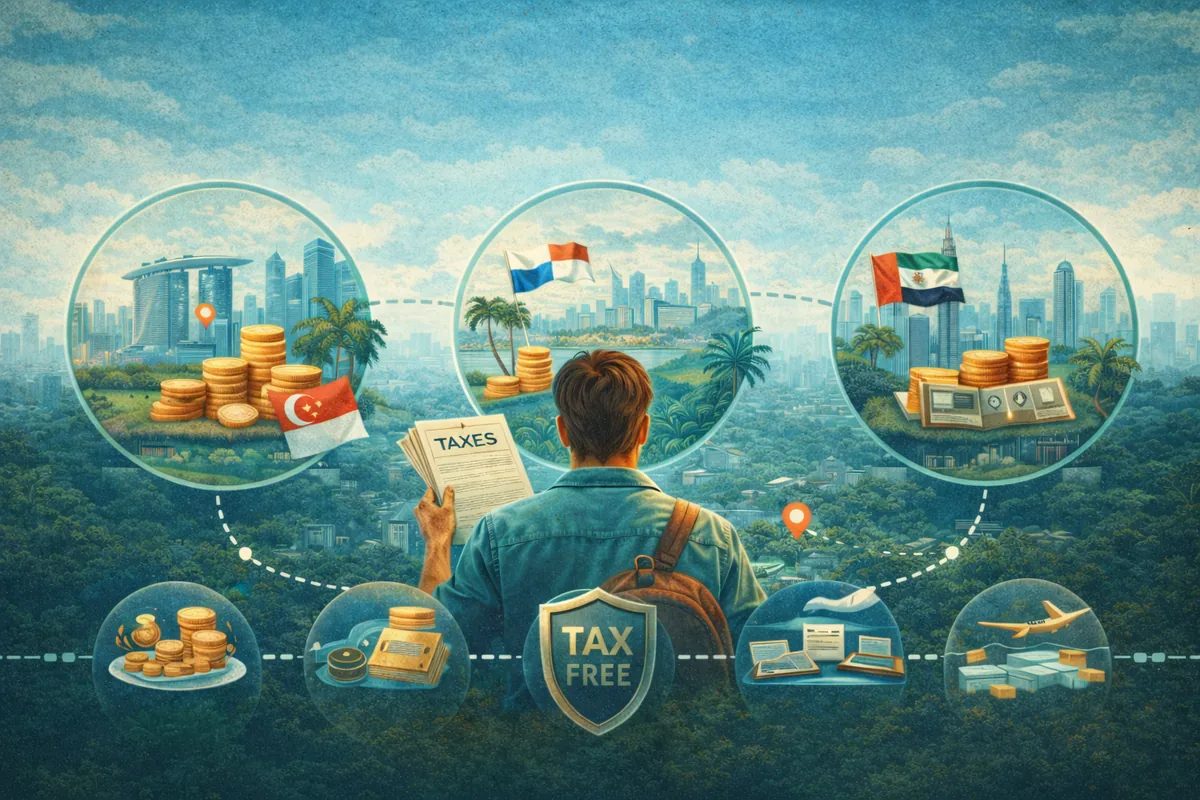
🌍 Understanding Territorial Tax Systems (And Who Actually Benefits)
 ByStephen
Wise
- Up to 75% cheaper than banks
- Multi-currency card usable in 160+ countries
- 70%+ transfers arrive in under 20 seconds
TLDR
- Source is King: Territorial tax systems only tax income earned within the country, completely ignoring foreign-sourced income. 📍
- Remote Work Edge: These systems primarily benefit digital nomads, international consultants, and entrepreneurs with offshore companies. 💻
- Residency Matters: You must officially trigger tax residency in the country to legally access the territorial benefits. 🛂
- The “Source” Trap: Physically working within the country can sometimes turn “foreign” income into “local” taxable income. ⚠️
- Strategic Alignment: Territorial systems work best when your business structure and residency are intentionally synchronized across borders. 🏗️
If you’ve spent any time looking into relocation or international tax strategies, you’ve likely come across the term “territorial tax system.” On the surface, it sounds simple.
A country taxes only income generated within its borders and ignores income earned abroad. That is the general idea, but once you start applying it to real life, things get much more nuanced.
The difference between what people think it means and how it actually works is where most confusion, and legal trouble, begins.
What “Territorial Taxation” Really Means 📜
A territorial tax system focuses strictly on the source of income. If the income is considered local, it is taxable; if it is considered foreign, it may not be taxed at all by that jurisdiction.
This is the polar opposite of worldwide taxation systems, like those in the US or UK, where residents are taxed on global income regardless of where it is earned.
- The Reality Check: While a system might be labeled “territorial,” each country has a different “flavor.” For example, the Panama individual tax rules are famous for their strict adherence to the territorial principle.
Other countries like Costa Rica and Malaysia are also frequently cited as examples. They generally tax income derived from local economic activity, while foreign-sourced income is treated differently.
Read Also: Moving to Panama
The Source of Income Is Where Things Get Tricky 🗺️
This is where people tend to oversimplify their setup. It is not just about where your clients are located or where the money is physically paid.
Tax authorities look at where the “economic activity” takes place. If you are physically sitting in a chair in a country, even working for a client in London, that income might be considered locally sourced.
Expert Tip: Never assume “foreign client = foreign income.” In many jurisdictions, the act of you performing the work locally is enough to trigger a tax bill.
In some jurisdictions, remote work performed within the country can fall under local taxation regardless of where the payer is. You should consult a digital nomad tax guide to see how specific regions view this distinction.
Who Actually Benefits From Territorial Systems 🏆
Not everyone benefits equally from territorial taxation. The biggest winners are people whose income is clearly generated outside the country where they live.
Think of online business owners, consultants working with international clients, or investors earning income from foreign assets.
| Winner Category | Why They Benefit |
| Crypto Investors | Gains from foreign exchanges usually stay tax-free |
| Digital Nomads | Income stays outside the local net if structured right |
| REIT Investors | Foreign dividends aren’t touched by local authorities |
| Consultants | Serving clients in a different hemisphere |
Export to Sheets
If structured properly, and depending on local rules, that income may fall outside the scope of local taxation entirely. But you must align your activities with how the country defines “foreign-sourced.”
Read Also: Assets Abroad
The Role of Tax Residency 🏠
A territorial system only applies to you if you are actually considered a tax resident of that country. Residency rules vary, but they often depend on physical presence or your “center of life.”
Spending a certain number of days in a country can trigger tax residency, but it is not the only factor. Some countries look at where you have a permanent home or where your family lives.
- The “Center of Life” Audit: If you have a house, a car, and your kids go to school in a country, the tax office will likely claim you as a resident regardless of your “day count.”
This means you cannot just “be around” and assume you benefit from the system. You need to meet the residency criteria properly to ensure you aren’t accidentally Avoiding Double Taxation.
Common Misunderstandings That Cause Problems ❌
There are a few recurring mistakes that come up again and again in the expat community. One is assuming that having a foreign company automatically makes income “foreign-sourced.”
If you are managing and operating that company from your laptop within the territorial country, authorities may consider that income locally generated.
Another common issue is ignoring reporting obligations. Even in territorial systems, you may still need to declare foreign income, even if it is not ultimately taxed.
Expert Tip: “Tax-free” does not mean “rule-free.” Compliance is still mandatory to keep your residency status secure and your bank accounts open.
Read Also: Banking in Other Countries
How Different Countries Apply Territorial Rules 🌍
Not all territorial systems are created equal. Some countries apply a strict interpretation, taxing anything that has any connection to local activity.
For example, certain jurisdictions in Southeast Asia have historically taken a more practical approach to foreign income. However, in recent years, some have updated their frameworks to clarify treatment for remote workers.
- Latin America vs. Asia: Latin American territorial systems often have very detailed sourcing rules, whereas Asian systems might focus more on whether the money is “brought into” the country.
You always need to look at the specifics of each country to see how they handle Exploring Emerging Markets.
Why Structure Matters More Than Location 🏗️
You can live in a territorial tax country and still end up paying more tax than expected if your business structure is off.
The way your business is set up, where it is managed, and how your income flows all play a role. If your company is registered in one country but effectively managed in another, different rules apply.
Expert Tip: Simple is usually better. The setups that work best are consistent and line up logically so there are no grey areas that need constant interpretation.
If you are an entrepreneur, choosing Where to Set Up a Business is just as important as where you choose to live.
Combining Territorial Systems With a Base Strategy ⚓
A territorial tax system becomes much more powerful when it is part of a broader “base strategy.” Instead of relying on one country, you create a setup where your residency and income are aligned.
This does not mean complexity for the sake of it. It means being intentional about where each part of your life is based.
- The Alignment Test: Does your residency country recognize your business country? Is your income flow clean? If yes, you’ve achieved the “Gold Standard” of international living.
You might live in a country with territorial taxation while running a business that operates internationally and keeps income clearly outside the local scope. This is a core part of becoming a Citizen of the World.
It Is Not a One-Size-Fits-All Solution 📐
Territorial taxation sounds like a magic bullet, but it does not work for every situation. If your income is tied to local clients, the advantages will be non-existent.
On the other hand, if your work is location-independent and your income streams are already international, the system is a perfect fit.
Read Also: Your Parameters for Moving Abroad
The key is understanding your own setup first, then choosing a jurisdiction that supports it. Do not chase a tax system; chase a system that fits your specific income source.
Conclusion 🏁
Territorial tax systems offer a clear framework, but they are often misunderstood by those looking for a quick fix.
The idea of only being taxed on local income is attractive, but the real benefit depends on how your income is structured and how authorities define the “source.”
Once you understand those moving parts, the concept becomes much more practical. Used correctly, it reduces complexity and gives you more flexibility.
But like everything in this space, it works best when it is part of a bigger plan, like Diversifying Investments Outside the Western Markets, rather than a shortcut.