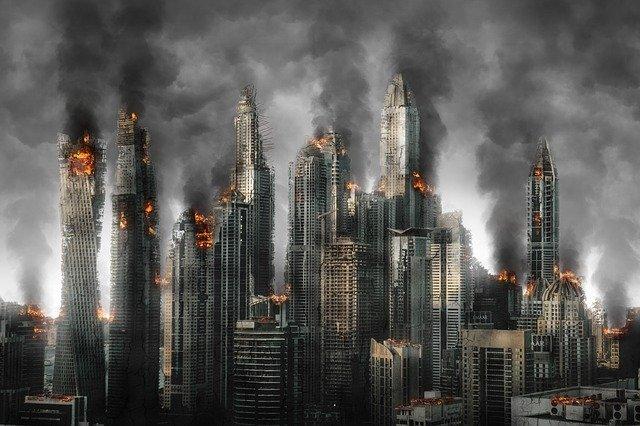
What causes the collapse of the West?
 ByStephen
Wise
- Up to 75% cheaper than banks
- Multi-currency card usable in 160+ countries
- 70%+ transfers arrive in under 20 seconds
The collapse of the West is inevitable
The collapse of the Western world is inexorable, and today we’ll talk about why this is so.
The Western World has been in steady decline for at least a few decades, but in the last several years it has accelerated rather rapidly.
It’s hard to point at a single moment in time or a singular event and say “That’s where it started. That was the beginning of the end”.
- Was it when Nixon took the dollar off the gold standard?
- When people started and then kept electing the lesser of two evils? Biden, Trump, Starmer, Merkel, Trudeau, Macron … all of these politicians have done their part in ensuring the collapse.
- With the rise of social media, fucking up people’s psyche and destroying entire generations?
- Tolerated and even invited Islamic terror into Europe?
- A massive increase in debt, leading to a rapidly rising cost of living and unending inflation?
- Concurrent wars across the world, many instigated by the US, but also due to the West’s involvement in Ukraine/Israel/Iran and many other, smaller issues?
- The “refugee” crisis, which saw uncounted millions of young, unemployable, often criminal men enter the West, taking advantage of its weakness?
Probably not just one of them, although they all definitely contributed.
When will it collapse?
Nobody knows for certain. It most likely won’t be tomorrow, next year, or even in the next ten years – but it could.
The West takes up a vast region of the world with very strong and old roots.
It won’t go down easily, but down it will go regardless. What this will look like and how it’ll manifest itself, nobody knows – but you can rest assured that the Western world in 2036 will look vastly different from today.
Western society is probably the greatest achievement of mankind in many ways, which makes its collapse all the more tragic.
It might go down around 2040 – 2050, but it’s impossible to accurately predict because there are so many factors at play.
What is certain, however, is that you and I (unless you are already pretty old) will almost certainly experience the collapse of the West.
And if not fully, at least its ramping-up-phase, which I believe will start in earnest in 2026.
Today, September 15th 2026, as I’m updating this article, the following new events have happened that underline and strengthen my prediction:
- War with Iran keeps going/potentially escalating
- War with Russia keeps going/potentially escalating
- War between Israel/Palestine keeps going/potentially escalating
- Tens of thousands of invaders have crossed the border from Morocco to Spain
- The “far right” political movements in Europe are gaining traction and winning elections – small ones right now, but it’s spreading
- The US national debt has breached the 40 TRILLION mark, which means it has doubled in a decade
- The US has casually strolled into sovereign nations like Venezuela to kidnap their president, to 0 repercussions
- The US president has been toying with the idea of just taking Greenland, a part of Europe
- The coherence and strength of NATO has never been lower
It has been collapsing for several decades now and it looks like the West is on its last legs.
Europe will almost certainly collapse faster than the US and Canada, but they won’t be far behind.
But… Europe/the US/Canada is still a great place to live!
Now, is the West a decent place to live right now?
Certainly, especially compared to shitholes like Afghanistan or North Korea.
That being said, MANY cities in the West now have crime rates comparable or even higher than most cities in 2nd or 3rd world countries!
Of course, for anyone coming from such countries, moving to the West is definitely an upgrade in general.
If you’re a sheep herder in the hills of Morocco or Afghanistan, getting casually banged by your uncle on the regular and you can’t do anything about it due to “family honor” – invading Spain and then making your way to other European nations where you’ll get free money, housing and access to white women and kids who, according to your belief system, deserve to get raped, seems like a pretty good deal, so why wouldn’t you go for it?
But that doesn’t mean things are great for people currently living in the West. On the contrary – and that’s where this article and its second part are dedicated to.
And it certainly doesn’t mean the situation will not escalate rather rapidly, turning the once-great Western World into an economic and social death trap.
Will other countries not also collapse when the West falls?
Those who are closely linked to the economy of the West will definitely feel its impact, but not nearly as much as the actual Western countries will.
For example, do you think nations like Paraguay or Peru will be heavily affected when France or Germany goes down? They’ll hear about it, shrug, and then get on with their lives.
I’ve done my best to research this matter as thoroughly as possible, and from all the information I can gather, the inevitable decline of the West is due to roughly 5 major factors:
- An untenable economic welfare system based on debt
- Political polarization and civil unrest
- Mass immigration of barbarism
- The death of civil liberties
- The emasculation of society
Dozens of books could be written about any of these topics, and they are vastly complicated and complex issues.
(in fact, I’ve done just that!)
And hundreds of other, smaller factors are also at play.
I’m not a scholar, and you don’t have time to plow through dozens of books, so I’ll do us both a favor and give you a brief overview of each of these factors.
Remember, these are just meant as a background story, to provide some context for the premise of this site: actually escaping the West.
In today’s article I will tackle the first two great causes, and in the sequel we’ll talk about the others.
An untenable economic welfare system based on debt
Let’s start with the most glaring and probably most disastrous reason why the West is doing so poorly, and will continue to do so at an ever increasing pace.
Why do nations fail? Very often it’s because their economies fail. And most Western countries are in debt, often massively so.
As of September 2026, the rough national debt figures of several large Western countries look approximately like this:
- United States: $40 trillion ($31 trillion in 2021, an increase of 29%)
- United Kingdom: $4.4 trillion ($3.1 trillion in 2021, an increase of 42%)
- France: $4.2 trillion ($3.1 trillion in 2021, an increase of 35%)
- Italy: $3.7 trillion ($3.1 trillion in 2021, an increase of 19%)
- Germany: $3.5 trillion ($2.7 trillion in 2021, an increase of 30%)
- Canada: $2.8 trillion ($2.1 trillion in 2021, an increase of 33%)
- Spain: $2.0 trillion ($1.6 trillion in 2021, an increase of 25%)
- Australia: $1.1 trillion ($0.7 trillion in 2021, an increase of 57%)
- New Zealand: $0.16 trillion ($0.12 trillion in 2021, an increase of 33%)
Those are frighteningly huge numbers, and they’re increasing every day, as you can tell from the 2021 values.
The United States remains by far the most indebted country in absolute terms in the entire history of the world.
While debt has always been part of modern economies, the speed at which it has grown in recent years is historically unusual.
Just look at the aforementioned figures… in 5 years’ time, the US debt has gone up roughly 30%, in the UK it’s 42%, France 35%, Germany 30%, Canada 33% and Australia a whopping 57%!
Surely you can understand that this kind of increase in debt does not bode well, to put it lightly.
Large budget deficits, rising interest costs, and ongoing AND GROWING government spending mean that a significant portion of tax revenue is increasingly used just to service existing debt rather than to fund new development.
And pay for the massive welfare systems … but more on that later!
Another important factor is that higher debt levels make economies more sensitive to interest rates.
When central banks raise rates to combat inflation, governments themselves face higher borrowing costs.
This creates a difficult balancing act: keep rates low and risk persistent inflation, or raise them and increase the financial strain on both governments and citizens.
Either path comes with trade-offs that can impact long-term economic stability.
The economists in charge often rely on monetary expansion and deficit spending as tools to manage economic slowdowns.
This effectively increases the money supply over time, which can contribute to inflation if it outpaces real economic growth.
Why does inflation matter?
Inflation, if you didn’t know, is a hidden tax. Every year, the price of products rises slightly.
Today, you might have to pay $5 for a Happy Meal, but next year that could be $5.20.
Chump change, you might say!
But small, steady and repeated increases become a huge problem after many years.
Your money is worth less and less as the years go by.
The purchasing power of most major currencies has declined significantly over the past decades, and moderate inflation remains a policy target in many economies.
Here’s the average inflation rate of some prominent Western nations over the past decade:
- United States: 3.1%
- United Kingdom: 3.3%
- France: 2.2%
- Italy: 2.2%
- Germany: 2.8%
- Canada: 2.8%
- Spain: 2.4%
- Australia: 2.9%
- Belgium: 2.8%
- Netherlands: 2.8%
- Ireland: 2.1%
- New Zealand: 3.0%
Doesn’t look so bad, I hear you think? You’d be wrong.
Even at a meager 2–3% annually, inflation compounds meaningfully over time.
This is why people who hold large amounts of cash over long periods see its real value erode.
Saving money all your life, hoping to retire with a cozy nest egg becomes more uncertain when inflation consistently reduces purchasing power.
You might amass a relatively large sum of, say, 1 million dollars, which is still a considerable amount of money today.
But whether it maintains the same purchasing power in 20 to 30 years depends heavily on inflation, investment choices, where you decide to bank and broader economic conditions.
I’ve done the calculations, and if you take an average inflation of 3% per year and a principal sum of USD 1 million, here’s what’ll happen to the actual purchasing power:
Purchasing Power of $1,000,000 at 3% Annual Inflation
Timeframe | Real Purchasing Power (Today’s $) | Value Retained | Total Loss in Value |
10 Years | $744,093.91 | 74.4% | 25.6% |
20 Years | $553,675.75 | 55.4% | 44.6% |
30 Years | $411,986.76 | 41.2% | 58.8% |
That’s over half of your money’s purchasing power gone, even with the meager 3% number.
Retirement
Let’s zoom in on the word “retire”, and how flawed the entire concept is.
There are two parts to this argument: one is about “retiring”, and one is about a “pension” – they’re not the same thing.
First off, retiring should only be for people who do not like what they do for a living. If you love what you do, why would you ever fully retire?
You can cut down on the amount of work you do, certainly, but why quit completely?
Secondly, if you rely on a pension or a retirement fund of any sort provided by an external party, you are betting your future on the good-will, benevolence and prosperity of your nation.
Which, as you can deduce from the premise of this site, is something I think is very unlikely to be tenable in the future.
Across much of the Western world, pension systems are under pressure due to demographic changes.
Populations are aging, birth rates are declining, and the ratio of workers to retirees is shrinking.
This means fewer contributors are supporting a growing number of beneficiaries, which puts strain on pay-as-you-go systems and public finances.
Let me paraphrase Harry Browne’s seminal book “How I Found Freedom in an Unfree World” – an absolute must read.
The only security a government-funded retirement offers is an illusory promise to use other people’s money to take care of you.
Not an iron-clad strategy by any means.
Retirement funds are a massive expense for governments, and more and more people will start to dip into them.
The average life expectancy has increased significantly over the past decades, and in many developed countries it now sits well into the late 70s or 80s.
As a result, retirement periods can last 20 to 30 years or more, extending the duration over which pensions need to be paid out.
More and more people will need to work for more and more years of their life in order to keep this system going, and in fact many countries have already begun raising the official retirement age or adjusting benefits to reflect this reality.
In addition, pension systems are often linked to broader economic performance.
Factors such as inflation (which we’ve discussed), investment returns, and government fiscal policy all influence how sustainable these systems are over time.
When these variables shift unfavorably, benefits may be reduced, eligibility tightened, or purchasing power diminished.
Money will be needed, money will be created, and over time this can contribute to further pressure on currency value depending on how it is managed.
This is especially important for expats and their families.
Welfare
Welfare is a very nice utopian moral claim, a dubious triumph of Western prosperity, but it has gone WAY too far.
I understand and even somewhat sympathize with the concept of taking care of the needy, but I strongly disagree with forcing others to do this.
Welfare should be a voluntary thing, funded by charities, not something the government FORCES you to be a part of, taking over half of your income at gunpoint.
And that’s not even taking into account this absolute fact:
Far too many people abuse the system and get paid for doing nothing.
While this is definitely a big problem in the US (like the recent millions of dollars Minnesota welfare scams conducted by, overwhelmingly, migrants from Somalia), it pales in comparison to the pickle the more socialist European countries are in.
Not only are their citizens receiving massive welfare packages for not working, for their retirement, and their healthcare, this monetary magnanimity extends to their “come one, come all” immigration policy, which of course leads to many tens of millions of invaders coming to Europe, to get a piece of the shrinking pie.
Randy “Mad Genius” Gage put it this way:
“The perfect citizen for a government is a needy one, because the more you need the government, the more controllable you are. As a creative, thinking human being, you are up against a mass of people who want something for nothing and governments around the world who want to give it to them.”
Welfare can create feedback loops, where reliance on benefits influences political preferences, and political incentives in turn reinforce existing systems.
These politicians will then have no choice but to cater to their base and keep the welfare gravy train going.
At the same time, reforms to welfare systems are often politically sensitive. Attempts to reduce benefits, raise eligibility thresholds, or introduce privatization elements can lead to public protests and strong opposition.
This reflects the reality that many people depend on these systems for their livelihoods, making abrupt changes difficult to implement without social disruption.
It cannot end, it gets worse every year, and even if the government tries to reduce the vast scale and disastrous impact of this system, it sometimes gets met with stubborn and shortsighted resistance from the populace, like a drug addict whose quick fix gets taken away for his own benefit.
For example: In November 2022, hundreds of thousands of people took to the streets of Madrid in Spain to protest the government’s potential privatization plans regarding their healthcare system.
Instead of realizing that their current system was untenable in the long run and something had to change if the nation were to survive, people just wanted their free ride to keep going, long-term consequences be damned.
And these are many of the same people that go on “refugees welcome” marches, inviting millions of migrants from Africa to come to their country and get free money …. Fucking idiots, honestly.
I’m not an economist, and I cannot explain the monetary crisis we are heading towards much better than this, but I’ve read plenty of research that backs up my rather pessimistic view.
In addition, there is a large body of ongoing research and debate around how sustainable current welfare models are in the decades ahead.
I can save all of these researches a shitload of time and money by using common sense: they’re not sustainable at all.
A factual summary
Western governments are spending more money than they have and are able to squeeze from the tax payers AT GUNPOINT (on wars, welfare, policing and “improving” the world, global aid, etc), and thus at some point the entire system will crumble.
And even if this massive debt bubble does not explode in our faces, can you really argue with these FACTS about Western economies?
Taxes
Westerners are among the most heavily taxed people in the world. You might not realize this, but if you’re an average employee is any Western nation, you are paying anywhere from 30 to 60% (or more!) of your income in taxes, be it apparent or hidden taxes.
Letting the government take half of the money you earn is absolutely ridiculous in my eyes, but for most Westerners, this is just a daily reality.
They aren’t aware of it, and even if they are, they do nothing about it – while they could (by setting up Bases across the world, or just getting the fuck out of their country).
Welfare dependency
More and more people will be drawing on welfare, be it in the form of pensions or unemployment checks.
This welfare has to be funded somehow, and taxing the already massively overtaxed tax-payers isn’t even the worst option.
Printing money is, because the large (hyper-) inflation this will cause will be devastating for millions of people.
Unhealthy economies
Western economies are for the most part stagnant or in a bubble. Yes, the S&P500 has been steadily rising through every decade so far, but do you think this would still be the case without the help of the Federal Reserve?
Bailing banks out by printing shitloads of money to prop them up, to maintain the illusion of prosperity while letting the average middle-class worker pick up the bill is not my idea of a healthy economy.
All of this points to the sobering fact that the West is long overdue for an enormous economic crash, the likes of which the world hasn’t seen in a very long time, perhaps not ever.
Sure, its economy might recover, due to using the same techniques that brought it about, but the underlying issues will not go away, and it would only be postponing a much worse collapse later on.
Political polarization and civil unrest
Politics is one of the most divisive topics you can imagine, which, in my opinion, is insane.
Put two people in the same room, and they could get along swimmingly on a variety of topics.
Even if they don’t agree on everything, most people would be happy to agree to disagree on their differences.
Before (we’re talking more than a few decades ago), people from opposite sides of the political spectrum (whatever that means) surely disagreed on many issues, but very rarely did these disagreements turn into violence.
Is that still the case today?
The US
Let’s start with the United States, where the division and vitriol between the “left” and the “right” has never been bigger.
This is funny and ironic, because they’ve actually never been more in tacit agreement on most large issues.
Both sides favor a big, strong government, censorship, more taxes, suppression of the influence and freedoms of people whose opinions they don’t agree with, and so on.
Like Harry Browne put it:
“Left-wing politicians take away your liberty in the name of children and of fighting poverty, while right-wing politicians do it in the name of family values and fighting drugs. Either way, government gets bigger and you become less free.”
It’s not uncommon nowadays for couples to break up because of political differences (no matter how small), friendships to get ruined, people to receive daily death threats (credible or not) and just face massive hostility for a difference of opinion.
And that’s all politics is: opinions.
The civil and healthy way to deal with standpoints you disagree with, like: “I think drugs should be legal”, “I’m fine with the government taking half of my pay check” or “Abortion is a woman’s right”, should be something like:
“Okay. I disagree with your opinions, but we are both adults, so let’s agree to disagree. We, and similar minded people, vote for whichever candidate represents us best, and abide by the results.”
Or, as I would advocate, to not get involved in politics whatsoever and leave the West so you aren’t hindered by them.
Not: “You disagree with me? NOW YOU MUST DIE!”.
Or get fired, cancelled, protested against or actually harmed.
Yes, there has always been a division between political parties, particularly in a two-party system, but recent years have seen increased polarization.
Several other factors could be blamed, such as Donald Trump (by far the most divisive POTUS ever, no matter if you support him or not), cancel culture and political correctness, but as far as I can tell, the underlying culprit here is social media, where algorithm-driven content can reinforce existing beliefs and reduce exposure to opposing viewpoints.
This is called an echo chamber, and it certainly plays a big part because people aren’t used to seeing or interacting with other points of view.
I won’t go into details about the vicious cycle of these echo-chambers, but suffice to say that social media are a cancer upon society and their benefits do not outweigh their heavy cost, of which the extreme political polarization is only one element.
Violence
Not only are the American people more divided than ever, their differences stray from the theoretical discourse more and more into the realm of actual action and violence.
Large-scale demonstrations have occurred across the political spectrum, some of which have escalated into property damage or clashes with law enforcement.
Just to name a few examples: Antifa, Black Lives Matter, Proud Boys, MAGA, Hamas-supporters etc.
These are all groups with strong political beliefs, an expressed and unreasonable hatred towards the “other side” and a tendency towards rioting, destruction of public and private property, and generally making the world a worse place.
This is called civil unrest, and it will become more and more common for Americans to have to deal with regular rioting and vandalism, for whatever bullshit reason.
The police state
A side-effect of this growing tension is an increased focus on law enforcement preparedness.
Police departments in many major cities have access to more advanced equipment and crowd-control tools than in the past, partly as a response to large-scale protests and security concerns. This has sparked ongoing debate about the appropriate balance between public safety and civil liberties.
Gone are the days when a town could be managed by a few police officers with some handguns.
Nowadays, police forces are sporting riot gear, automatic rifles, tear gas, water cannons, bazookas, and even tanks.
They are basically turning into paramilitary forces – also known as militias.
Do you think this will alleviate or exacerbate the current level of civil unrest?
For example, in 2020 hundreds of protesters took over entire city blocks in the city of Seattle for multiple days and dubbed it the “Capitol Hill Autonomous Zone”, following violent clashes between protesters and law enforcement.
This was part of the Black Lives Matter movement, and came about in protest against police brutality against African Americans, calling for a defunding of the police.
Division by states
Another issue is the “states” part of the United States.
It has always been a habit of labeling states either red or blue, denominating which political faction it predominantly votes for.
But as the political chasm widens, several states are making more and more noise towards secession from the country and going their own way.
Currently, that’s all this is, noise.
As the years go by, however, it might turn into something more, and this is a possible scenario of how the collapse might play out.
We’ll tackle this in another article.
Canada and the EU
In Canada, political polarization and civil unrest are much less of a factor at the moment.
Canadians are rather placid in that respect and while there will always be outlying violent groups, it doesn’t seem like Canada will experience nearly as much civil unrest as the US will, but it isn’t immune to it by any means.
The 2022 Freedom Convoy protests highlighted how quickly disagreements over policy can escalate into nationwide disruption, including blockades at key border crossings that affected trade with the United States.
Since then, Canada has continued to experience debates around cost of living, housing affordability, and immigration levels, all of which have contributed to a more active and sometimes polarized political environment.
While these issues are typically handled within institutional frameworks, they do reflect growing pressure points within Canadian society.
The EU will go down soon
Europe (specifically the EU), on the other hand, could very well tear itself apart.
Much can be said about this topic, but not much is needed.
Even if we put aside the growing political unrest within countries (way less extreme than in the US, but still present), we need only look at Brexit to catch a glimpse of the future.
The United Kingdom separating from the EU was only the first big step towards its collapse.
Currently, a few other countries are seriously considering this move, such as Poland and Hungary. And in most other countries, there are political parties advocating the split.
As of 2026, there is no immediate wave of countries exiting the EU, but friction between member states and EU institutions continues to surface.
Disagreements over fiscal policy, national sovereignty, rule-of-law standards, and more and more often, migration policy have been particularly visible in countries like Hungary and Poland.
While full withdrawal is not currently imminent, these tensions show that unity within the bloc is not guaranteed.
Civil unrest in Europe does occur way more frequently now than ever before, though it tends to be more localized and issue-specific.
In recent years, some protests have been linked to rising living costs, energy prices, pension reforms, and agricultural policies, with demonstrations in countries like France, Germany, and the Netherlands.
Sure, these things happen, but they’re usually peaceful and part of living in a democracy.
But more often than not, civil unrest (with riots, vandalism, etc.) has to do with the third great reason for the collapse of the West, the mass immigration of barbarism – the invasion of the Western world by migrants from, mostly, Africa and the Middle East.
We’ll talk about this in Part 2 of this article.
Wise
- Up to 75% cheaper than banks
- Multi-currency card usable in 160+ countries
- 70%+ transfers arrive in under 20 seconds






Wow just found your content. Totally agree.
If you want to look, which countries are eager at failing just look at this page at Wikipedia
https://en.wikipedia.org/wiki/Expatriation_tax
The west is ending and I am leaving this sinking ship soon, too.
Hello Octavian! Glad to hear we’re on the same page here. Interesting article you’ve shared, thanks!
Good luck escaping the West, you’ll be better off for sure.